

In Brief:
I corrected false information on Facebook this morning. The person who posted it deleted the evidence, accused me of trolling, and blocked me. This wasn’t some random keyboard warrior spouting rubbish in a comments section. This was someone claiming to be a leading expert on violence against women and children in the UK, someone who runs conferences and training programmes, someone who states they “don’t post anything without absolutely fact checking.”
The false claim? That more than 400 Reform UK members have criminal records, with 233 currently serving sentences. Sounds damning, doesn’t it? Problem is, those statistics weren’t about UK Reform at all. They were from a 2019 news article about Estonia’s Reform Party. Completely different country.
Completely different political party. Same name.
When I pointed this out with the actual Estonian source, I wasn’t thanked for the correction. I was labelled as “triggered,” accused of “copy paste bombing,” and then silenced. This is how misinformation thrives in 2025. Not because people can’t access the truth, but because they actively construct barriers to prevent it reaching them.
When Fact-Checking Gets You Blocked: A Case Study in Social Media Misinformation
Tuesday morning, 28th October 2025. A Facebook post lands on my feed claiming Reform UK is a threat to women and children, backed by precise statistics: 400+ members with criminal records, 233 still serving sentences, 20% of MPs convicted of violence against women or children.
Lies, damn lies.
More than 400 reform members have a criminal record.
233 are currently still serving their sentences.
20% of their MPs have been convicted of violence against women or children.
Their leader pushed for Brexit while stashing millions offshore and admitting on national news the day after that his claims were lies.
He also voted for more tax loopholes for billionaires.
None of the reform MPs have called out their members for child abuse. They have kept their places.
I say this as a leading expert on violence against women and children in the UK.
If you support #ReformUK, you are supporting a threat to women and children’s safety.
Do feel free to hit the block button on your way out if you disagree.
The poster, name redacted, describes herself as a leading expert on violence against women and children. She runs business name redacted, organises conferences, delivers training. Legitimate advocacy work, by all accounts.
But these statistics felt off.
A quick search revealed why. Those exact numbers, EXACT NUMBERS, 442 individuals with criminal records and 233 serving sentences, appeared in a February 2019 article from Estonian news outlet ERR. Not UK Reform. Estonia’s Reform Party.
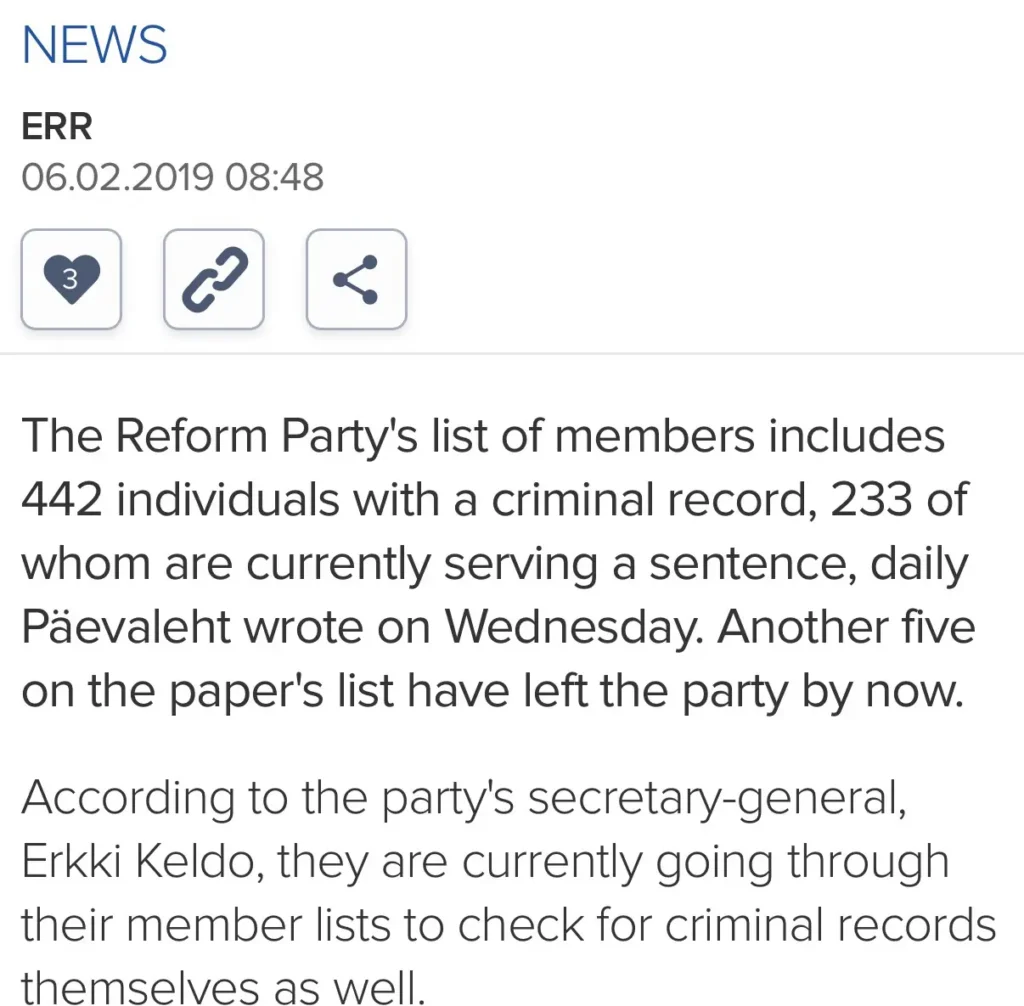
Completely different political entity in a completely different country.
She used the EXACT numbers from the Estonian article:
The Reform Party’s list of members includes 442 individuals (she said over 400) with a criminal record, 233 of whom are currently serving a sentence, daily Päevaleht wrote on Wednesday. Another five on the paper’s list have left the party by now.
Would you like the truth?
Claims 1 and 2 are completely false! They are about Estonia’s Reform Party from 2019, not UK Reform.
Claim 3 was technically accurate in early 2025 (1 out of 5 MPs = 20%) but is no longer current (and therefore no longer true) as McMurdock left the party in July 2025, and the statistic lacks crucial context that makes it deeply misleading.
But, hey. Who cares about truth?
I posted the correction with the source link (this one: https://news.err.ee/907867/more-than-400-reform-members-have-criminal-record-233-serving-sentence). Clean, factual, no personal attack. Just: “These numbers are from Estonia’s Reform Party, not UK Reform.”
Then things got interesting.
The DARVO Response
Rather than acknowledge the error, The person deployed what psychologists call DARVO: Deny, Attack, and Reverse Victim and Offender.
Research by Dr. Jennifer Freyd shows this pattern is common when people are confronted with evidence they’d rather not address. Studies have found that observers exposed to DARVO tactics rate the actual victim as less believable and more responsible for harm, whilst sympathising with the perpetrator.
First came the accusation that I was “triggered.”
Then the claim I was “trolling.” For commenting to different parts of the thread to different people. Erm… that’s exactly how threaded forum type things work.
Then the phrase “copy paste bombing” appeared, a creative bit of terminology for the act of posting factual corrections in a threaded Facebook conversation where multiple people were engaging with her false claims.
She also stated something rather remarkable about UK libel law: “The responsibility is not mine to prove I’m telling the truth, the party in question has to prove that what I’ve said is false.”
I’m no legal expert but, sorry, that seems completely backwards.
Under the Defamation Act 2013, defamatory statements are presumed false unless the defendant can prove they’re substantially true. The burden of proof sits entirely with the person making the claim, not the person being defamed. She got the law precisely the wrong way round whilst claiming she “absolutely fact checks” everything before posting.
Delete, Block, Carry On
Then came the deletion. The post containing the false Estonian statistics vanished, taking with it all the corrections that proved her wrong. Facebook’s “Post has been removed by its owner” message appeared. Not long after, I found myself blocked.
It turns out what was deleted was my correction, with a screenshot of the original article and link to it, not her full post.
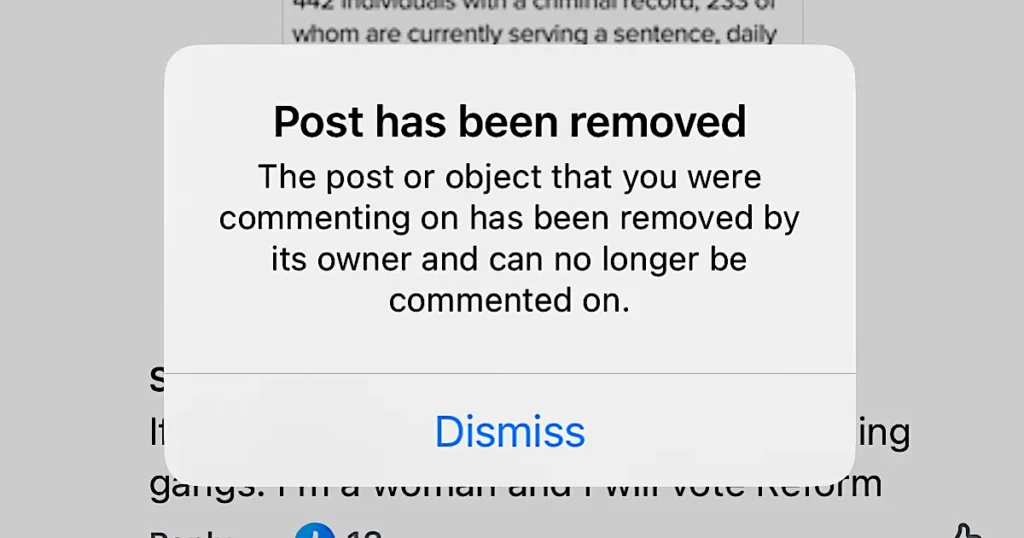
This sequence matters.
- Delete first to remove the evidence.
- Block second to prevent future fact-checking.
It’s calculated damage control, not an honest mistake corrected in good faith.
Anyone who can see her original post claiming these statistics about UK Reform will continue believing that’s true (the blind-folded echo chamber). They never saw the correction because it was deleted. They don’t know it was about Estonia.
The lie spreads, unchallenged, in the minds of everyone who read it before deletion.
Research on echo chambers and misinformation shows exactly this pattern. When people selectively remove opposing viewpoints and block those who challenge them, they create what scientists call “network segregation.” This systematically disrupts democratic dialogue and, more troubling, makes false information spread faster than corrections. Studies found that echo chambers “deprive people of a reality check, leaving them in a virtual reality” where implausible messages thrive.
Why This Matters
I didn’t challenge this person’s advocacy work (I applaud it), her lived experience as a survivor, or her right to speak about domestic abuse (more people should do the same – I talk about mine and hear about others at Andy’s Man Club).
I challenged one specific claim with verifiable evidence. That’s it. A straightforward factual correction with source material.
The response wasn’t “Thank you, I’ll correct this.” It was
- deflection,
- personal attack,
- evidence removal, and
- silencing.
This is textbook misinformation mechanics at work.
What makes this particularly troubling is that legitimate advocacy requires truth. You can’t fight one injustice by fabricating another. Two wrongs don’t make a right as they say.
Using false statistics to smear a political party, regardless of what you think of that party, undermines the entire basis of credible advocacy. Reform UK has enough actual, documentable problems without needing to borrow Estonia’s political baggage.
James McMurdock, the Reform MP for South Basildon and East Thurrock, was indeed convicted in 2006 of assaulting his then-girlfriend, serving 21 days in a young offenders’ institution for kicking her around four times. When Reform had five MPs in January 2025, that one conviction equalled the “20% of MPs convicted of violence against women” statistic. Technically correct, but utterly misleading without context. It’s one person out of five, not some systematic pattern requiring fake Estonian statistics to bolster the argument.
She may have had valid arguments to back up her post but she used incorrect data to do so!
Real accountability requires real facts. When advocates spread false claims and then attack anyone who points out the errors, they damage both their own credibility and the causes they champion.
The Broader Pattern
This isn’t just about one person getting statistics wrong. It’s about how social media platforms and human psychology combine to create environments where misinformation thrives and corrections die.
Studies on combating misinformation show that false claims spread quickly and cheaply, whilst corrections require evidence, nuance, and time.
- The liar gets the engagement and big ego stroke.
- The fact-checker gets blocked.
- Those in the echo chamber are denied the facts.
- The platforms profit from the outrage either way.
Research also shows that people who learn about DARVO tactics before encountering them are significantly better at recognising manipulation and holding perpetrators accountable.
Knowledge is defence. That’s why documenting these patterns matters.
You see it everywhere now.
- Post false information with authority.
- When challenged, accuse fact-checkers of being “triggered,” “trolling,” or politically motivated.
- Delete the evidence.
- Block the critics.
- Return to your echo chamber where supporters never saw the correction and still believe you’re meticulous and expert.
Truth becomes optional. Authority becomes self-declared. Accountability gets deleted. Critics get blocked.
And on it goes.
What Can Actually Be Done
- Document everything.
- Screenshot claims before they vanish.
- Save source links.
- Keep contemporaneous notes of what happened and when.
I’ve done exactly that here because once you’re blocked, you lose access to evidence of what was said.
Challenge misinformation when you see it, but do it with evidence and without personal attacks. I provided the Estonian news source. I didn’t question the original poster’s lived experience or advocacy credentials. I corrected one false claim with verifiable proof.
Understand that you might get blocked anyway. That’s not failure. That’s the misinformation playbook in action. Your correction still reached some people before deletion – hopefully. That matters.
Teach others to recognise these patterns.
- DARVO deflection.
- Echo chamber construction.
- Selective deletion of corrections.
- Authority claimed without credentials verified.
When people know the tactics, they’re harder to manipulate.
And perhaps most importantly, hold the same standards for “your side” as you would for opponents. I’d challenge false claims about Labour, the Tories, the Lib Dems, or anyone else with equal vigour.
Truth doesn’t have a political allegiance, and neither should fact-checking.
This morning I encountered someone who mixed up countries, got the law backwards, deployed textbook deflection tactics, deleted evidence, and blocked anyone who challenged them. All whilst claiming to be meticulous about fact-checking and an expert in their field.
That’s social media in 2025.
The infrastructure is built for engagement, not accuracy. The psychology rewards tribal loyalty over factual precision. The tools enable instant evidence destruction and critic silencing.
But documentation survives deletion. Facts outlast deflection. And people who care about truth, regardless of political leanings, can still call out bollocks when they see it.
Even if it gets them blocked.
The Wriggle: When Caught Red-Handed
If you’re still with me, I applaud you. This bit deserves your next couple of minutes…
Before the comment deletion and my blocking, there was an attempt at damage control that deserves examination. When confronted with the Estonian source proving the statistics were from a different country’s political party entirely, the response wasn’t acknowledgement. It was deflection wrapped in semantic gymnastics.
“Martin Koss no, while two of the figures are the same, my stats are about the UK reform party.”
Read that again. “While two of the figures are the same.” Not “You’re right, I made an error.” Not “I’ve mixed up countries.” Instead, an admission disguised as a rebuttal. Yes, the numbers match Estonia’s Reform Party data, but allegedly the stats are still about UK Reform.
That’s impossible.
Those exact figures, 442 individuals with criminal records and 233 serving sentences, appear only in the February 2019 Estonian news article. There is no source containing those identical numbers about UK Reform. None.
What this statement actually does is create plausible deniability. By acknowledging “two of the figures are the same,” she’s attempting to suggest there’s legitimate UK data that just happens to overlap with Estonian statistics. It’s an admission that those numbers ARE from Estonia, repackaged as though there’s some additional UK source that conveniently uses identical figures. Except that source doesn’t exist.
This is textbook manipulation when caught with evidence. Can’t deny the Estonian connection because the source has been posted. Can’t admit to copying foreign statistics and applying them to UK politics because that destroys credibility. Solution? Semantic wriggling. Acknowledge the smallest possible truth whilst implying the bigger claim remains valid.
Research on how people respond when confronted with their own misinformation shows this exact pattern. Rather than admitting error, there’s often an attempt to reframe the mistake as partial truth, create confusion about what was actually claimed, or suggest additional evidence exists without providing it. The goal isn’t correction. The goal is maintaining the appearance of authority whilst minimising accountability.
“While two of the figures are the same” means “You’ve caught me, but I’m going to phrase it in a way that suggests I still have legitimate data.” It’s the political equivalent of being caught with your hand in the biscuit tin and claiming you were just checking they’d not gone stale.
This isn’t about making an honest mistake and being too embarrassed to admit it publicly. This is calculated reputation management prioritising ego over accuracy. When someone claims to absolutely fact check everything before posting, then gets caught using foreign statistics, then tries to minimise it with vague language about overlapping figures, then deletes all evidence, they’re not engaging in good faith advocacy. They’re engaging in misinformation with damage control.
The psychological impact of this matters. Hundreds of people absorbed those false statistics as fact. Many never saw the correction. Those who did see it got treated to semantic gymnastics that created confusion rather than clarity. When the original false claim says “more than 400 reform members have a criminal record” with the authority of claimed expertise, the damage is done. Trying to wriggle out with “two of the figures are the same” doesn’t undo the hundreds of people who now believe UK Reform harbours hundreds of criminals based on Estonian data.
Questions about Fact-Checking and Online Accountability
What Should I Do If Someone Blocks Me After I Fact-Check Their Post?
Document everything before you lose access. Screenshot the original claim, your correction with sources, and any responses you received. Once you’re blocked, you can’t retrieve evidence of what was said. Consider whether the issue warrants a public article or blog post with your documentation, but always weigh the value of public accountability against potential legal risks.
Is It Defamation If Someone Posts False Statistics About a Political Party?
Under UK law, defamation requires that a false statement causes serious harm to reputation. Political parties can be defamed, though they face higher hurdles than individuals in proving serious harm. The key defence is truth: if you can prove your statement is substantially accurate, you’re protected. Posting statistics about the wrong country’s political party whilst claiming they apply to a UK party could potentially be defamatory if serious harm results.
How Can I Verify Statistics I See on Social Media Before Sharing Them?
Copy the specific numbers and search them in quotation marks on Google. This often reveals the original source within seconds. Check the publication date, the country of origin, and whether the context matches the claim being made. If you can’t find a credible source within five minutes, don’t share it. The burden is on you to verify before amplifying potentially false information.
What Is DARVO and Why Does It Matter in Online Debates?
DARVO stands for Deny, Attack, and Reverse Victim and Offender. It’s a manipulation tactic where someone caught doing something wrong denies the behaviour, attacks the person who called them out, and positions themselves as the victim. Research shows that observers exposed to DARVO often end up sympathising with the actual perpetrator whilst doubting the credibility of the person who raised legitimate concerns. Recognising this pattern helps you avoid being manipulated by it.
Can I Be Sued for Calling Out Someone’s False Claims If I Have Proof They’re Wrong?
Truth is an absolute defence to defamation in UK law. If you can prove your statements are substantially true, you’re legally protected. However, stick to facts you can verify and avoid personal attacks or speculation about motives. Focus on what was said, why it’s false, and what the evidence shows. Document everything and keep your tone measured and factual rather than inflammatory.
Why Do People Delete Posts Instead of Correcting Them When Proven Wrong?
Deleting removes the public record of being corrected, allowing the false narrative to persist in the minds of everyone who saw the original but missed the correction. It’s damage control prioritising reputation over accuracy. An honest correction posted publicly would acknowledge the error and prevent the misinformation from continuing to spread, but that requires admitting fault, which some people find intolerable.
Should I Keep Challenging Misinformation Even If It Gets Me Blocked Repeatedly?
Yes, but choose your battles strategically. Document your corrections, focus on claims that genuinely matter, and maintain a factual tone without personal attacks. Getting blocked isn’t failure, it’s evidence that you hit a nerve with uncomfortable truth. Your correction will reach some people before deletion, and that matters more than maintaining access to someone’s echo chamber.
Sources
More than 400 Reform members have criminal record, 233 serving sentence
news.err.ee
Jennifer Joy Freyd, PHD. What is DAVRO?
jjfreyd.com
Defamation Act 2013
legislation.gov.uk
Participants exposed to the perpetrator’s DARVO rated the victim as less believable
reddit.com
On the impossibility of breaking the echo chamber effect in social media
nature.com
Reform MP James McMurdock was jailed for repeatedly kicking girlfriend
news.sky.com
Countering Disinformation Effectively: An Evidence-Based Policy Guide
carnegieendowment.org