
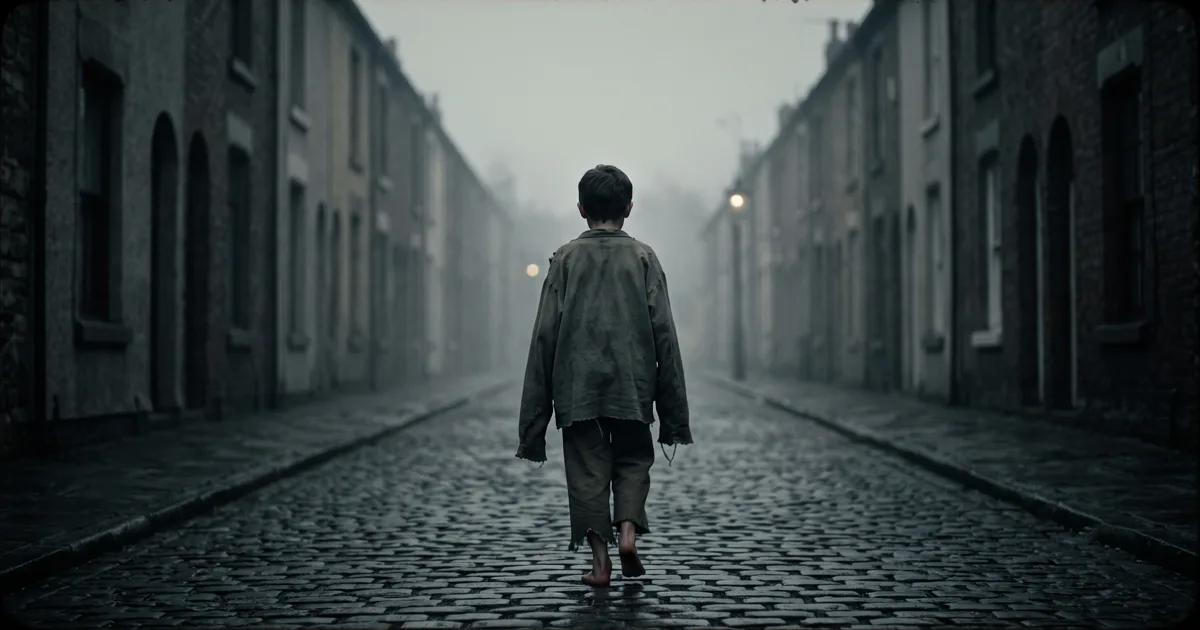
I remember hearing something in the news, years ago, about people saying they didn’t ask to be born.
I can’t remember the exact story now. It might have been someone threatening to sue their parents. It might have been one of those social media arguments that sounded completely ridiculous at first, then somehow ended up everywhere.
At the time, I probably thought what most people thought.
What a stupid thing to say.
Of course you didn’t ask to be born. Nobody did. That’s how being born works. None of us were floating around in some celestial waiting room, reading the terms and conditions before ticking a little box marked “yes, I accept”.
But the thought stayed with me.
I didn’t ask to be born.
And I definitely didn’t ask to be born into what I was born into.
Fear as part of the furniture
I didn’t ask to arrive in the middle of an unstable marriage. I didn’t ask to become the punch bag when I was still a toddler. I didn’t ask to spend the best part of my first two decades living in fear.
That sounds dramatic when you put it like that. I know it does.
But it’s also true.
Fear wasn’t an occasional visitor. It was part of the furniture. It was there in the house, in the atmosphere, in the silences, in the footsteps, in the changes of mood you learnt to detect before you had the words for any of it.
You don’t understand that sort of thing as a child. You just adapt to it.
You become careful.
You become quiet.
You become good at reading rooms. Good at noticing danger. Good at trying not to make things worse. Good at shrinking yourself until you take up as little emotional space as possible.
And then, years later, people call that your personality.
What I didn’t ask for
I didn’t ask to be bullied.
I didn’t ask to be neglected.
I didn’t ask to be used as unpaid labour around the house and garden while still being made to feel like I was the problem.
I didn’t ask to grow up carrying the consequences of childhood emotional neglect, adverse childhood experiences, abuse, shame, embarrassment and all the other rubbish that gets packed for you before you’re old enough to understand what’s happening.
I didn’t ask for a head full of fear.
I didn’t ask for no self-confidence.
I didn’t ask to grow up with my self-esteem crushed by things I couldn’t control, didn’t cause and didn’t have the tools to deal with.
And I didn’t ask to spend so much of my life feeling ashamed of being me.
That’s the bit that’s hard to explain to anyone who hasn’t lived it.
Shame gets into everything.
It doesn’t always announce itself as shame. Sometimes it looks like awkwardness. Sometimes it looks like anger. Sometimes it looks like overthinking, avoidance, people-pleasing, perfectionism, depression, anxiety, self-sabotage, or sitting in a room full of decent people and still feeling like you shouldn’t quite be there.
You can spend decades trying to fix yourself before realising you were reacting to things that happened to you.
Things people did.
Things people said.
Things you were blamed for.
Things you should have had as a child and didn’t get.
Responsibility is not the same as blame
And yes, I know adults have to take responsibility for their own lives.
Of course we do.
At some point, nobody else can live your life for you. Nobody else can do the work inside your head. Nobody else can rebuild your confidence for you, or do the slow work of noticing how the past still comes out in the present.
Taking responsibility now doesn’t mean pretending everyone had the same start.
Saying, “This is mine to deal with now,” is not the same as saying, “This was all my fault.”
It wasn’t all my fault.
That has taken me a very long time to say without immediately trying to explain myself out of it.
I didn’t ask to be groomed.
I didn’t ask to be manipulated.
I didn’t ask to be abused as a young adult.
I didn’t ask to be called names, worn down, confused, blamed, shamed, or made to believe I somehow deserved the way I was treated.
I didn’t ask for any of that either.
And yet, there it all was, stacked on top of what was already there.
It is not always one big moment
Trauma doesn’t always arrive as one clear event.
It isn’t always one obvious moment you can point at and say, “That was it.”
Sometimes it’s layer upon layer.
A childhood where you don’t feel safe.
A home where love is unreliable.
A school where you’re bullied.
A young adulthood where the damage makes you vulnerable to more damage.
Then years of trying to function like a normal adult while still dragging all of it around inside your own head.
You go to work.
You pay bills.
You have conversations.
You try to be useful.
You try to be funny.
You try to look like a person who knows what you’re doing.
And even when things are calm, your head is still waiting for the next problem.
That sounds exhausting because it is exhausting.
Living every waking hour dreading the next thing is exhausting.
Trying to prove you’re not useless is exhausting.
Trying to earn your right to exist is exhausting.
Trying to look confident when your foundations were kicked away before they had a chance to settle is exhausting.
And the daft thing is, from the outside, people don’t always see it.
They see the adult version. Job. Business. Family. A sense of humour. A bit of sarcasm. A face that usually manages to do what faces are meant to do.
They don’t see the child inside who learnt very early that being noticed could be dangerous, but being ignored hurt as well.
That’s a strange little trap, that one.
You want to be seen.
You’re terrified of being seen.
You want someone to notice.
You don’t want anyone looking too closely.
So you get through the day, then the next one, then the next one. You become self-contained. You make everything your problem because depending on other people never felt like a sensible bet.
You learn to cope, and after a while people assume that means you’re all right.
Plenty of people know this feeling
I’m not writing this because I think I’m special.
Sadly, I’m not.
Plenty of people will recognise parts of this, even if their details are different.
They grew up in homes, schools, families, relationships or situations they had no control over. They were left dealing with things that were never theirs to begin with. They learnt ways of coping before they knew that was what they were doing.
Then they reached adulthood already carrying patterns they never chose.
For some, it comes out as anger. Others bury themselves in work. Some find ways to numb it. Some become the funny person, the dependable person, the difficult person, the quiet person, or the person who never asks for help because asking feels too risky.
A lot of people just keep going, mainly because stopping was never an option.
That’s the part I keep coming back to.
I didn’t ask to be born.
I didn’t ask to be born into fear.
I didn’t ask to carry the mental scars of abuse, neglect, bullying, grooming, manipulation and shame.
But I did have to live with them.
And I still do.
The good things do not cancel out the damage
That doesn’t mean life has been only misery. It hasn’t.
There have been good people, good moments, love, laughter, dogs, daft conversations, work I care about, and more cups of tea than any medical professional would probably recommend.
But I think it’s dishonest to pretend the good things cancel out the damage.
That’s one of the things people get wrong about mental health, especially when the damage started early.
They’ll say, “That was the past.”
Yes. We know.
That isn’t the clever insight people seem to think it is.
We know it was the past. We know we’re not there now. We know we’re adults. We know we have responsibilities, people who care about us, better days, safer rooms, different lives.
But the past doesn’t politely stay where it happened.
It follows you in the way your body reacts before your brain has had a chance to explain anything. It follows you in the tone of voice that suddenly makes your stomach drop. It follows you in the need to apologise when you haven’t done anything wrong. It follows you in the way you dread the next thing, even when there’s no obvious next thing coming.
The good things help.
Sometimes they make life bearable. Sometimes they give you moments of peace, connection, warmth, even joy. Sometimes they remind you that life is not only damage.
But they don’t make the old stuff disappear.
They sit alongside it.
You can be grateful for parts of your life and still be affected by other parts of it. You can love people and still know there are parts of you that didn’t get the start they needed. You can build a life and still feel, some days, as if one awkward shove would send half of it wobbling.
Still trying
Maybe that’s what I want to say here.
I’m not writing this to accuse the universe, sue my parents, or make a performance out of pain.
I just want to say it plainly.
I didn’t ask for any of this.
I didn’t ask for the fear, the shame, the bullying, the neglect, the abuse, the self-doubt, the dread, the crushed confidence, or the years spent trying to understand why being alive felt so much harder than it seemed to feel for other people.
But I’m here.
Almost 60 years in, somehow.
Still carrying it.
Still questioning it.
Still trying to understand it.
Still trying to build a life that belongs to me, not one that is endlessly shaped by what other people did.