

Political commentary increasingly runs on the same mechanics as a content farm: a provocative social post drives clicks to a paid platform, and the strength of the argument matters less than whether it converts.
Matt Goodwin’s Facebook post about the murders of Jo Cox and Ann Widdecombe raises a fair question about double standards on political violence, but the Substack article behind it stretches the evidence and sits behind a subscription pitch.
The question deserves a straight answer. The packaging around it doesn’t.
I saw a Facebook post by Matt Goodwin asking why Britain had held a national debate about the far right after the murder of Jo Cox, but apparently no equivalent debate about the far left after the murder of Ann Widdecombe.

I thought it was a legitimate question.
So I clicked.
Which, of course, was the point.
The Facebook Post Is the Advert
The short post was there to draw people towards the full argument.
It asked why the murder of Jo Cox prompted a national debate about the far right while Ann Widdecombe’s murder had apparently produced no equivalent discussion about the far left. It also questioned why politicians spoke openly about an alleged far-right plot in Suffolk while warning against speculation in Widdecombe’s case, despite evidence suggesting greater acceptance of violence and harassment among some people on the left.
Those are powerful questions.
They’re also very effective at stopping somebody scrolling.
There’s an apparent injustice, an accusation of hypocrisy and the suggestion that something important is being hidden. The reader is invited to feel that the answer is obvious, while politicians and the media are refusing to admit it.
I clicked because there was something there worth thinking about.
The problem became clearer when I reached the article itself.
There Is a Legitimate Question Here
Political violence from the left should be examined seriously.
That shouldn’t be controversial.
Violence, intimidation and harassment don’t become more acceptable because the person committing them uses the language of equality, liberation or social justice. If people are being threatened or attacked because of their political beliefs, the ideology behind it deserves the same scrutiny whether it comes from the left, right or anywhere else.
There are also fair questions about how politicians and journalists talk about suspected political violence.
Are they quicker to attach an ideological label when the suspected motive comes from the right?
Are they more cautious when the suspected ideology comes from the left?
Do universities, charities, broadcasters and government institutions devote more time and money to studying one form of extremism than another?
Those questions deserve serious examination and clear answers.
The wording of Goodwin’s Facebook post had already decided the answers, before the questions were even asked.
Questions That Already Contain the Answer
There’s a difference between asking whether a double standard exists and phrasing a question that assumes it does.
Goodwin’s post doesn’t leave much room for uncertainty.
It presents the murder of Ann Widdecombe as a far-left murder, even though the political motive was still being investigated. It suggests there’d been no debate at all, rather than arguing that there hadn’t been an equivalent debate. It says the evidence shows that people on the left are more accepting of violence, without explaining what evidence, which people, which country or what kind of violence is being measured.
The question marks make the claims appear slightly more cautious.
The verdict is still there.
The implied explanation is that politicians and journalists protect the far left, apply different rules when the accused comes from the right and ignore polling that doesn’t suit them.
Perhaps parts of that are true.
But a question isn’t evidence simply because the answer feels plausible.
Then I Reached the Substack
The longer article begins with a headline about one of the most important speeches “the establishment doesn’t want you to hear” and evidence “they don’t want you to see”.
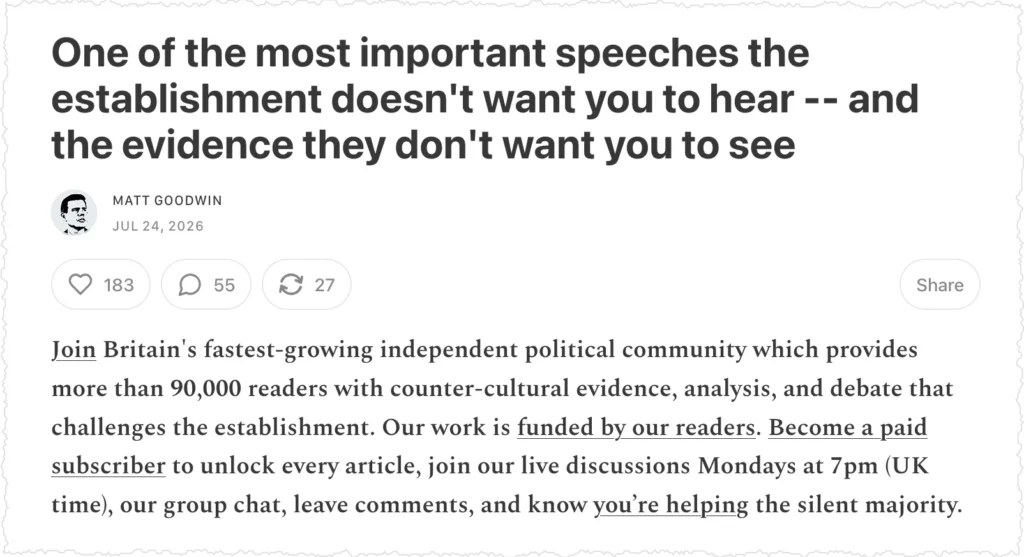
Before the political case begins, readers are told that Goodwin runs Britain’s fastest-growing independent political community, reaching more than 90,000 people. They’re invited to become paid subscribers, unlock every article, join live discussions and support the “silent majority”.
That changes the context.
Goodwin is making a political argument while also selling access to more of his political commentary.
There’s nothing inherently wrong with that. Writers need paying. Independent publications cost money to produce. Reader funding can allow people to publish work that newspapers, broadcasters or political parties might avoid.
But it creates its own pressures.
The writer no longer needs only to be read.
They need readers to return, subscribe and continue paying.
Everyone’s Got a Substack Now
Well, almost everyone.
Not me.
Substack has made it easy for journalists, politicians, former politicians, academics, campaigners and commentators to build their own small media organisations.
They can publish without an editor. They can grow an audience through Facebook, X, YouTube or podcasts. They can collect email addresses and eventually persuade some of those people to pay for deeper analysis, exclusive material or access to a private community.
That can be a good thing.
It can also turn political commentary into a recurring revenue business.
Once that happens, attention has a direct financial value.
Anger has a financial value too.
So does fear, suspicion, outrage, belonging and the feeling that you’re being told something the establishment would rather you didn’t know.
Goodwin may believe everything he writes.
Sincerity doesn’t remove the commercial incentive surrounding the content.
Political Content Has a Conversion Rate
Businesses understand this already.
A social media post catches attention. A headline creates curiosity. A link moves somebody onto an owned platform. An email address gives continued access to that person. A subscription turns attention into recurring income.
The mechanics are familiar.
Political content now uses them too.
A Facebook post gives the reader the strongest, most emotionally loaded version of the argument.
The reader clicks through.
The longer article tells them that important evidence is being ignored, that mainstream institutions can’t be trusted and that this independent commentator is willing to say what others won’t.
Then comes the invitation to join the community.
The subscribers are presented as members of the “silent majority”.
Paying for a subscription begins to feel like participating in a political cause.
Buying the article is framed as supporting people brave enough to speak. The reader joins others who can see through the official story and help challenge the establishment.
That’s powerful marketing.
It works because it sells identity as much as information.
The Argument Becomes Cleaner Than the Evidence
Goodwin’s longer article contains points worth examining.
There may be inconsistent treatment of suspected ideological violence. There may be under-recognition of far-left extremism. Some people on the political left clearly do justify harassment or violence when they believe the target deserves it. The way certain institutions treat communist language compared with fascist language is worth discussing.
But the article repeatedly takes complicated evidence and turns it into something much cleaner.
Ann Widdecombe’s possible political motive becomes an established far-left motive.
A lack of equivalent national soul-searching becomes “deafening silence”.
Polling showing disturbing attitudes among some left-leaning groups becomes proof that people on the left are consistently more accepting of violence.
Different incidents from Britain, America, France, Greece and elsewhere are gathered together as evidence of one broad, growing threat.
Universities, media organisations, charities, schools and cultural institutions become a “circle of tacit support”.
By the end, the argument has moved a long way from asking whether far-left violence receives enough attention.
It’s become a claim that large parts of Western public life quietly protect, excuse or encourage it.
That’s a serious allegation.
It needs more than a collection of examples that point in roughly the same political direction.
The Jo Cox Comparison Isn’t Exact
The comparison between Jo Cox and Ann Widdecombe carries much of the emotional weight.
It’s understandable why.
Both were prominent political figures. Both were targeted. Both cases raised immediate questions about political motive.
But they were at different evidential stages.
After Thomas Mair murdered Jo Cox, evidence of his far-right beliefs became extensive and direct. His statements, possessions, research and behaviour all formed part of the eventual case.
In Widdecombe’s case, a possible political motive was still being investigated when Goodwin wrote his article.
A political motive remains entirely possible.
We can consider that possibility without declaring which ideology caused the murder before the evidence has been tested.
Goodwin’s stronger question would’ve been:
If the investigation establishes that Ann Widdecombe was murdered because of her political beliefs, will Britain examine far-left extremism with the same seriousness it applied to far-right extremism after Jo Cox?
That still challenges politicians, journalists and institutions.
It simply doesn’t announce the result of an investigation in advance.
“The Evidence Shows” Usually Needs Another Sentence
Goodwin refers to polling suggesting that people on the left are more willing to justify violence or harassment against political opponents.
That deserves attention.
Any significant number of people saying political violence is acceptable should concern us, regardless of their party.
But “the evidence shows” can conceal more than it reveals.
What was the exact question?
Who was surveyed?
Were they being asked about physical violence, verbal harassment, protest, criminal damage or murder?
Was the target described as racist, fascist, Islamist, communist, anti-immigration or something else?
Were we measuring the entire political left, particular activist groups or voters for individual parties?
Those distinctions are important.
A person telling a pollster that violence might be justified against somebody they consider a fascist isn’t automatically expressing support for political assassination.
It may still reveal a dangerous willingness to excuse aggression.
It just doesn’t prove every wider claim attached to it.
Goodwin’s article also discusses respondents supporting a “communist revolution”, then connects that answer directly to regimes that killed millions.
Again, there may be something troubling in the polling.
But what did respondents understand by the phrase?
Were they endorsing Soviet-style dictatorship, public ownership, abolishing capitalism or simply choosing an inflammatory anti-establishment answer in a survey?
People regularly give contradictory, careless and performative answers to political polls.
The findings deserve attention, but the most alarming interpretation shouldn’t automatically be treated as the most accurate.
When Commentary Starts Looking Like a Content Farm
Political commentators would probably dislike the comparison.
The mechanics are becoming hard to ignore.
A content farm takes a subject people care about, creates the strongest possible headline, removes awkward uncertainty and promises to reveal what others have missed.
The social post provokes the emotion.
The website captures the traffic.
The page asks for continued attention, an email address or payment.
Then the process starts again.
Independent political platforms can do exactly the same thing.
Social media creates the urgency, every new story becomes part of a wider betrayal, and powerful institutions are accused of hiding the truth. The reader is then directed towards a platform the commentator controls and encouraged to subscribe before the next supposed revelation appears.
The political version has greater consequences than ordinary clickbait.
A misleading celebrity headline wastes a few minutes.
A misleading political argument can deepen distrust, harden divisions and persuade readers that anybody asking for caution is part of the cover-up.
Mainstream Media Isn’t Innocent
None of this lets newspapers or broadcasters off the hook.
Traditional media has used fear, outrage, division and selective framing for decades.
Newspapers need sales and subscriptions. Broadcasters need audiences. Commercial websites need page views. Even publicly funded media competes for relevance and attention.
Independent political creators didn’t invent sensationalism.
Some built their audiences precisely because people had lost trust in the established press.
Replacing proprietors and advertisers with paying subscribers simply creates a different source of commercial pressure.
A newspaper may worry about upsetting an owner, advertiser or political contact.
An independent commentator may worry about disappointing the paying audience that expects a particular interpretation of events.
The risk is different, but it’s still there.
The Audience Starts Shaping the Commentator
This is where things become more complicated.
A writer builds an audience by focusing on certain issues.
The audience follows because it values that focus.
Some readers begin paying because they trust the writer to keep examining those issues.
The writer then has a powerful incentive to continue seeing new events through the same frame.
The shift can happen gradually, without the writer making a conscious decision to mislead anyone.
Stories supporting the wider argument attract more attention. Uncertainty is interpreted in the direction the audience already expects. Contradictory evidence feels less urgent. Stronger language produces more shares and subscriptions. Moderation begins to look weak. A change of mind risks being treated as betrayal.
The writer may start by serving an audience.
Eventually, the audience can start deciding what the writer is allowed to see.
That’s audience capture.
It happens across politics.
The left does it. The right does it. Centrists do it while telling themselves they’re above it.
Paid platforms increase that pressure because audience approval directly affects the writer’s income.
I Clicked Because the Question Was Legitimate
Matt Goodwin isn’t the only person worth examining here.
I clicked on the post.
It raised something I already suspected might be true.
I’ve seen obvious double standards in political debate. I’ve seen people excuse aggression when they sympathise with the cause. I’ve watched politicians and journalists use very different language depending on who is accused and which political direction the accusation points.
The post pressed on an existing concern.
That’s why it worked.
It would be easy to tell myself that I clicked purely because I wanted to examine the evidence.
Perhaps I did.
But the anger, curiosity and suspicion built into the post helped.
We’ve become used to asking whether political content agrees with us.
We’re less practised at asking what it’s trying to make us feel, what uncertainty has been removed to create that feeling and where the click is taking us.
Something can contain a legitimate concern and still be packaged manipulatively, which makes it harder to judge fairly.
We can recognise the legitimate concern while questioning claims that go beyond the available evidence.
We can (and should) ask whether political violence from the left is being taken seriously enough while also asking whether a commentator is stretching the evidence to increase attention.
We can challenge institutional double standards without adopting weaker standards ourselves.
The Question Still Deserves an Answer
I still think the issue raised by Goodwin’s post deserves discussion.
If Ann Widdecombe’s murder is established as politically motivated, Britain should examine that motive without minimising it or treating it as an isolated act simply because the ideology involved is uncomfortable for certain institutions.
Polling showing support for political violence or harassment among sections of the left should be discussed openly.
Universities, journalists, politicians and public bodies should be questioned about whether they apply consistent standards to extremism.
None of that requires us to accept premature conclusions.
And none of it should prevent us asking what happens when the people making those arguments are also building paid political platforms that depend on keeping readers emotionally engaged.
The Facebook post made me stop.
It stirred enough anger to make me think and enough curiosity to make me click.
Then it led me to a subscription business built around the promise that important truths are being hidden and this commentator is one of the people willing to reveal them.
The political question may be legitimate.
I’m less convinced the post was designed to help us answer it.
It was the advert.
And it worked.
Political Commentary, Rage Bait and Paid Subscriptions
Why has political commentary become a subscription business?
More commentators now use platforms such as Substack to build paid audiences around political analysis. That gives them independence, but it also creates pressure to keep readers interested, emotionally engaged and willing to continue paying.
How can a Facebook post act as an advert?
A short Facebook post can use a provocative question or emotionally charged claim to stop people scrolling and encourage them to click through. The full article then becomes part of a wider sales funnel leading towards email sign-ups, memberships or paid subscriptions.
What is political rage bait?
Political rage bait is content designed to provoke anger, suspicion or outrage so people are more likely to react, share or click. It often begins with a legitimate concern, then removes uncertainty or exaggerates the evidence to make the argument more emotionally powerful.
Does monetising political content make it dishonest?
No. A writer can sincerely believe everything they publish while still benefiting financially from the attention it creates. The concern is whether the business model rewards stronger claims, selective evidence and repeated outrage over careful analysis.
What is audience capture in political commentary?
Audience capture happens when a commentator becomes increasingly shaped by the expectations of their followers. If the audience rewards one political interpretation with clicks, shares and subscriptions, the writer may feel pressure to keep presenting events through that same frame.
Why can political questions be misleading?
A question can appear open while already containing an accusation or preferred conclusion. Phrases such as “why is nobody talking about this?” may imply deliberate silence or concealment before the evidence has established that such a cover-up exists.
How can readers spot subscription-driven political content?
Look for claims that the establishment is hiding important evidence, repeated appeals to a silenced community, and links leading to paid newsletters or membership platforms. None of those features proves the argument is false, but they reveal the commercial incentive behind the framing.
Can a political concern be legitimate and still be rage bait?
Yes. A post may raise a real issue while presenting it with more certainty or drama than the evidence supports. Readers should examine both the underlying question and the way it has been packaged to attract attention.