
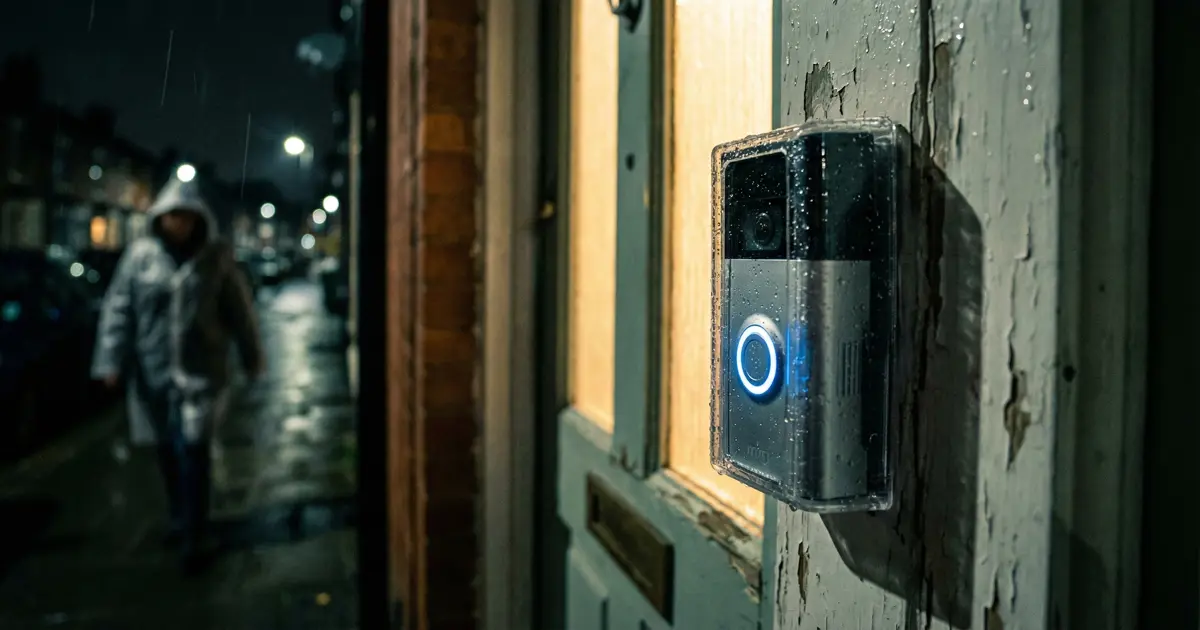
The tech companies want you to believe your fifty quid door camera makes you safer. In reality, you might be installing a 24/7 surveillance device for other people’s benefit, handing out free intelligence to burglars, and feeding a data machine that knows more about your life than your neighbours do.
This isn’t tinfoil hat stuff. It’s how these systems are built, how they’re used, how they are promoted and how they’re (sometimes) abused.
The comforting lie of the “smart” doorbell
The sales pitch is simple. A glowing button on the door, a neat app on your phone, and adverts showing a smug homeowner telling some suspicious bloke to sod off – while sipping a cocktail on a beach in Spain.
The message: this is power, presence, control.
Strip away the soundtrack and you’re looking at a device that loudly announces one thing to anyone half awake: this house is wired into a corporate surveillance platform and the person talking is very likely not behind the door.
A BBC Business piece in 2023 reported that British police forces were championing video doorbells as crime fighting tools, while also quietly admitting there was very little solid evidence they actually reduce crime at street level – especially once you control for other factors like lighting and neighbourhood watch schemes.
Scientific American went further in December 2023, examining the claim that devices like Ring “slash crime”. After looking at the available studies, it concluded the evidence was weak, inconsistent, and often based on poor methodology or marketing-driven pilots, not rigorous criminology.
So the core fantasy that “stick a camera on your door and crime melts away” is just that – a fantasy with a monthly subscription.
When the camera becomes a gift to burglars
One security ‘expert’ told me: “Your instinct about answering from work or the supermarket being a bad idea isn’t paranoia. It’s basic offender logic.“
Routine activity theory, which underpins a lot of modern crime science, says all we need are three things:
- a suitable target,
- a motivated offender, and
- no capable guardian.
Cameras and alarms are supposed to signal a capable guardian at play. The key word there is “capable”.
If some lad presses a Ring doorbell, hears a clear, echoey voice that might as well be coming from a car park, and sees no sign of movement inside, he’s learnt something. He knows the house is monitored, yes. He also knows the person talking is nowhere near the kitchen drawer with the rolling pin in it.
Research on CCTV and “guardianship” has hammered the same point for years: symbolic guardianship – like signs and stickers – only really works when it’s backed by real people who can intervene, not just recorded warnings and pretty branding. A video doorbell answered badly can easily drift into that “symbol only” category.
Former burglars, interviewed in pieces like TechRadar’s “do smart security cameras really deter crime?“, have also said the quiet part out loud: criminals pay more attention to evidence of real occupancy and response – like lights coming on, dogs, neighbours, and human reaction times – than to logos or camera domes alone. A smart camera that behaves like a recorded voicemail isn’t nearly as scary as the advert suggests.
The data you casually give away
Even if you never get burgled, the privacy price of these things is steep.
Mozilla’s Privacy Not Included project tore into the Amazon Ring video doorbell in 2021 for its default data collection and sharing practices, highlighting broad collection of personal information, video, audio, and metadata, plus extensive third party tracking in the app. The Cloud Security Alliance’s 2022 analysis of Ring as a case study pointed out that the product sits on top of Amazon’s cloud and commercial ecosystem, which is geared towards data retention, cross-service linkage, and monetisation – not minimal necessary collection.
Then you have the regulators. In 2023 the US Federal Trade Commission published details of Ring’s privacy failures, revealing that employees and contractors had accessed customer video in ways that went way beyond legitimate business need – including spying and harassment through home cameras – and that weak security controls left accounts open to takeover. As part of the settlement, Ring had to delete unlawfully accessed data and overhaul its internal access systems. The damage, of course, was already done.
In the UK, solicitors like Nelsons and BRM have been warning homeowners that under UK GDPR and data protection law, you can end up on the hook for breaching your neighbours’ privacy if your camera or doorbell captures their property or audio without proper justification and signage – especially if you hold that footage for long periods or share it casually. So it’s not just your own data you’re playing with. You’re also potentially dragging your street into a surveillance net they never consented to.
Law enforcement, emergencies, and the quiet creep of normalised surveillance
Supporters of these systems like to say everything is handled “lawfully” and “with warrants”. That’s generous.
Politico reported in March 2023 on what it called the “privacy loophole” in Ring’s relationship with US law enforcement, describing how the company had previously provided footage to the police in so-called emergency situations without user consent or a warrant – under subjective internal assessments of risk. The same article raised wider concerns about private camera networks becoming a de facto extension of state surveillance, without the usual public scrutiny or democratic controls.
In the UK context, the Greater London Authority’s video doorbell burglary initiatives show how quickly these devices get absorbed into policing strategy once they’re common in an area. On top of that, the National Cyber Security Centre now publishes guidance on “smart security cameras” because so many of them are internet-connected, remotely accessible, and vulnerable if badly configured. None of this is evil in itself, but it’s a quiet shift from your front door being your space, to your front door being another node for data extraction and police access.
You can decide that’s a price worth paying. But you shouldn’t pretend it’s not happening.
The marketing fairy tale of crime reduction
Crime reduction claims deserve a proper kicking.
Ring has repeatedly marketed “up to 55 per cent reductions in burglary” based on some US trials. When MIT Technology Review pulled those claims apart in 2018, looking at one of the flagship partnerships, it found that crime had been dropping in the wider area anyway and that in at least one location the control area without Ring actually had fewer burglaries than the Ring-equipped area over the same period.
In other words, cherry-picked statistics dressed up as proof.
More recent work on CCTV and property crime by academics writing in journals like Justice Quarterly has produced more measured conclusions: certain types of well-placed cameras, as part of wider environmental security changes, can reduce some crimes in some places, while displacing others, and sometimes doing very little at all. That’s not nearly as sexy as a glossy advert showing burglars fleeing the second they hear a stern voice through a tinny speaker.
The respectable middle ground is simple.
Cameras can deter some offenders, some of the time, in some contexts.
They’re not magical, they’re not universal, and they’re not an excuse to ignore locks, lighting, and very basic street-level common sense.
Real benefits, if you insist on using them
There is a case for these devices when you strip out the hype.
Secom, a security firm that’s actually done on-the-ground work with British homeowners, lists some practical gains:
- clearer identification of callers,
- useful evidence for parcel theft and car crime, and
- extra peace of mind for older or anxious residents who want to see what’s happening at their door without walking to it every time.
The same line appears in insurer guidance from Ageas, which points out that video doorbells can help you verify delivery disputes and check on your property when you’re away, but also notes that they bring privacy trade-offs and technical risks you need to manage.
If you live in a rough area, work late, or have health issues, being able to see and speak to whoever’s outside without opening the door isn’t trivial. For some people that really does make daily life easier and feel safer. And as long as you understand what it is and what it isn’t, there’s nowt wrong with that.
The problem starts when you treat a video doorbell as a magic shield instead of one tool in a bigger, more grounded setup.
Using cameras without being a mug
If you’re going to have one of these things anyway, at least make it work for you, not for everyone else.
Use it as a recorder first, a performance stage second. The real value is the footage you can refer back to when something actually happens, not playing Jason Statham over Wi-Fi. Save the live audio for moments where you genuinely want to interrupt something, and keep what you say vague. “Can’t get to the door right now” is information light. “I’m in the office until six, leave it with number 42” is practically an engraved invitation.
Minimise how much you give the platform. Choose end-to-end encrypted options if available, use strong unique passwords, turn on two factor authentication, and turn off as many “sharing”, “neighbourhood” and “third party integration” settings as the app will allow. Mozilla’s profile of the Ring doorbell showed how much extra tracking and cross-service sharing can be buried behind friendly toggles and optional features. You’re allowed to say no.
Think about your neighbours and your legal exposure. Angle cameras so they capture as little of other people’s property as possible, add proper signage if required, and don’t hoard footage for longer than you sensibly need. The Nelsons briefing on Ring under UK data protection law makes it very clear that “domestic use” has limits once you start pointing lenses and microphones across boundary lines. You don’t want to be the pillock who ends up in a tribunal because you fancied overseeing the whole cul-de-sac.
Finally, accept that a camera isn’t a substitute for a real presence. Get the basics right first: solid doors, serious locks, decent lighting, lived-in signals, actual relationships with the people either side of you. Then, and only then, ask yourself whether sticking an internet-connected eye on the wall is enhancing that, or just helping a large company build a better file on your life.
Sources:
Amazon Ring Video Doorbell | Privacy & security guide
mozillafoundation.org
Ring’s privacy failures led to spying and harassment through home security cameras
consumer.ftc.gov
Amazon Ring: A Case of Data Security and Privacy | Cloud Security Alliance
cloudsecurityalliance.org
The privacy loophole in your doorbell | Politico
politico.com
Video doorbells: Police champion them but do they cut crime? | BBC
bbc.co.uk
Do Video Doorbells Really Prevent Crime? | Scientific American
scientificamerican.com
Video doorbell firm Ring says its devices slash crime, but the evidence looks shaky | MIT Technology Review
technologyreview.com
Data Protection Law & Ring Doorbells | Nelsons Solicitors
nelsonslaw.co.uk
UK Data Protection Laws Vs Doorbells | BRM Solicitors
brmlaw.co.uk
Do smart doorbells really deter burglars? | Secom
secom.plc.uk
Should I get a Video Doorbell? | Ageas
ageas.co.uk
Video Doorbell Burglary Initiative | Greater London Authority
london.gov.uk
‘Smart’ security cameras: Using them safely in your home | NCSC
ncsc.gov.uk
Assessing the deterrent effect of symbolic guardianship | Psychology, Crime & Law
tandfonline.com
Assessing CCTV in Preventing and Reducing Property Crime
tandfonline.com
We ask a former burglar: do smart security cameras really deter crime? | TechRadar
techradar.com