
A few years ago, around 2017 or 2018, I was deep involved in mental health support. With help from my wife I’d built a mental health chat group online, dozens of members, people posting at all hours because that’s what people in crisis do.
No 9-to-5, no “back in the morning.”
I was also running weekly local meet-ups. Nothing formal, just a room and a kettle and a bunch of people who needed somewhere to sit with their anxiety for an hour.
It was, if I’m honest, taking its toll. On both of us.
Somewhere in all of that, I started exchanging messages with a bloke called Luke. He’d started a men’s talking group up in Yorkshire, a charity built around the idea that men should be able to talk, that there should be spaces for it, that silence kills.
Good principles. Admirable. The kind of thing I believed in and still do.
When Were You Ever Going to Be “Enough” for the People Trying to Help?
I don’t remember exactly how the conversation started. But I do remember how it felt when it started to go sideways.
Luke was hard to get hold of. Slow to reply. Understandable, I suppose, if you’re building something from scratch. But my brain doesn’t do “understandable” particularly well when it’s in a certain place.
There’s a thing called RSD, Rejection Sensitive Dysphoria, which tends to come packaged with ADHD. It means your nervous system reads silence as rejection. A delayed reply isn’t just a delayed reply. It’s evidence. It’s confirmation of the thing you already feared. You’re being ignored. You’re not worth the reply. You’re too much.
I probably got a bit arsey. I’ll own that.
But here’s where it gets interesting, and by interesting I mean bleak.
The communication ended because he found my mental health too difficult. That was the gist of it. The way my brain works, the paranoia, the responses when I felt ignored, it made things complicated. Too complicated.
A mental health support organisation, built on the premise that men need to be able to talk, needed me to be less mentally ill before they could deal with me.
Let that sit for a second.
Now look, I’m not going to pretend I was easy. I probably wasn’t. I’m not. And I don’t know what Luke was dealing with on his end, obviously. Building a charity is relentless, especially in those early days, and maybe I was one straw too many. I can accept that, to a point.
But there’s something in it, isn’t there? Something that doesn’t quite add up.
The people who most need support from mental health spaces are often the people those spaces struggle most to accommodate.
- Too anxious.
- Too reactive.
- Too much.
The irony barely needs pointing out.
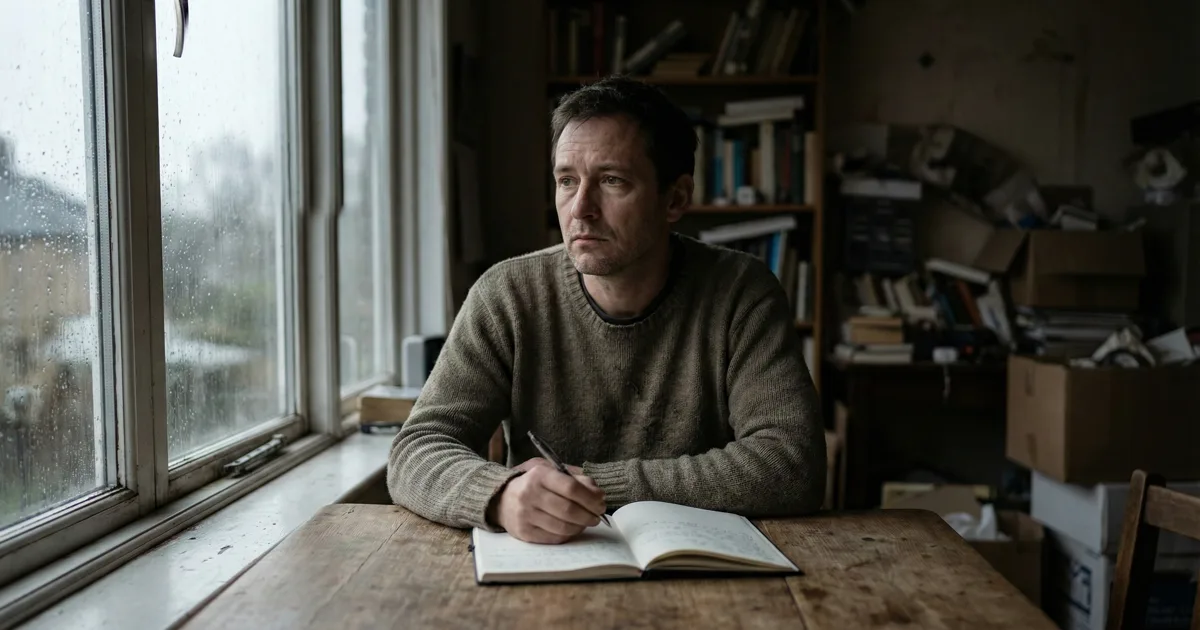
I scribbled some notes at the time. I was hurt, confused, probably a bit angry. I wasn’t looking for answers really, just somewhere to put it. That’s what writing is sometimes. You don’t always want to solve it. You just want it out of your head and onto paper.
What I’ve never fully resolved is the question underneath it all. At what point does someone become “too difficult” for a space that exists specifically because ‘difficult’ exists?
I don’t have an answer. I’m not sure there is one that doesn’t contain some uncomfortable truths about the limits of what people can genuinely offer, even with the best intentions.
Still here though.
I dug this one out because it still catches me. Not with the same sharpness as 2018, but it’s there.
If you’ve ever been told, directly or indirectly, that your particular flavour of struggling is a bit much for the room, you’ll know what this felt like. And if that’s you, I just want to say, that wasn’t the full picture. You weren’t too much. You were too much for that moment, with those people. That’s different.
I’m still here. And so are you. That’s not nothing.