
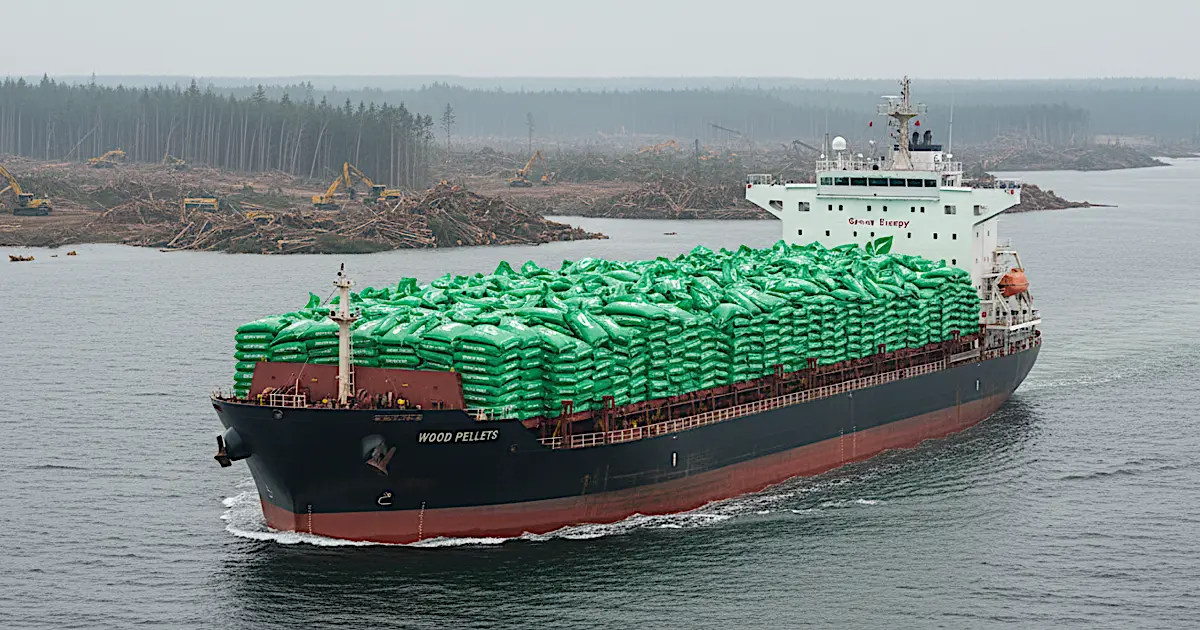
Biomass gets wrapped up in a lovely green bow and sold as the future of clean energy. Bags covered in trees, slogans about renewable heat, the whole eco-friendly image. But scratch the surface and you’ll see it for what it really is – (in my humble opinion – based on a lot of reading) a con dressed in green packaging.
This isn’t some shiny new scam. I remember many years ago, around 2002, sitting in a seminar about “the environment” while I was working extensively with a local manufacturing company. They had the projector out, glossy brochures, the whole song and dance about planting trees to “offset carbon emissions.” You know the waffle. Companies were being nudged to sign up for “green credentials” before they even knew what that meant.
Oh, and earn themselves a fancy green logo for their company in exchange for a yearly fee (of course).
Meanwhile – and this is the part they didn’t put in the slides – millions of trees were, and still are, being chopped down.
Chopped, mulched, dried, pressed into pellets with vast amounts of factory energy, hauled around by heavy machinery, stuck on container ships, and flogged as a green solution for heat and power.
The marketing spiel was about forests. The reality was more like factories and freighters.
Back in the early 2010s, when governments wanted quick wins to look like they cared about the climate, biomass suddenly became fashionable.
Never mind the facts, never mind the smoke coming out of the chimney. If you could burn it and call it renewable, it was hailed as “green.”
What Biomass Really Is
Forget the spin. Biomass in practice means wood pellets. Yes, WOOD! These aren’t twigs swept up from the forest floor. We’re talking whole trees chopped down in the US or Canada, ground up, dried, turned into pellets, packed into containers, and shipped across the Atlantic. Once here, they get dumped into power stations or sold in garden-friendly bags with pictures of smiling leaves on the front.
Call me old-fashioned, but chopping down forests thousands of miles away and sailing them across oceans doesn’t sound very green. It sounds like global deforestation rebranded.
The Dirty Truth About Burning It
And it gets dirtier.
Burning wood actually releases more CO₂ per unit of energy than coal. Not less, not the same. More. And because wood holds moisture, you’ve got to burn a lot more of it just to get the same energy output. That means more pollution, more fuel, more waste.
Yes, in theory, if you plant a new tree it’ll suck up some of that carbon – in 30 to 50 years’ time. In the meantime, the carbon is already in the atmosphere doing its damage. It’s like promising to pay your mortgage off one day while blowing the cash on nights out. The debt doesn’t vanish just because you said you’ll deal with it later.
The Shipping Problem
Even if the burning wasn’t dirtier than coal, there’s the small matter of transport. Biomass doesn’t just fall from the sky into UK power plants. It’s harvested, chopped, dried, pelletised, bagged, trucked to a port, shipped thousands of miles on heavy-oil container ships, then trucked again before it’s burnt.
That’s not carbon neutral. That’s global logistics for the sake of keeping politicians’ green stats looking tidy.
The Tree Planting Con
The sales pitch is always the same: “We plant a tree for every tree cut down.” Sounds noble, doesn’t it? But mature trees store vastly more carbon than saplings.
A 200-year-old oak is a carbon vault.
A baby sapling is basically a stick in the ground.
It’ll take decades before that newly planted tree makes a dent in the carbon debt left by the tree it replaced – that’s if it ever does.
In many cases, these “replacement forests” are fast-growing monocultures. Rows of identical trees with as much biodiversity as a car park. Nature doesn’t thrive in a plantation. It thrives in old growth forests we’re cutting down and shipping off by the tonne.
Marketing vs Reality
Biomass isn’t the green miracle it’s sold as. It’s worse than coal in many cases, dirtier, less efficient, and dressed up in eco branding to trick the public into thinking they’re helping the planet by burning forests.
Planting a new tree doesn’t erase the loss of an old one. Shipping wood halfway around the world isn’t renewable. And slapping a green label on a bag of pellets doesn’t magically make it environmentally friendly.
If we are serious about climate change we would leave those forests alone and start actually reducing emissions in transport and manufacturing instead of playing accounting games with wood pellets. But as usual, governments and corporations went for the option that looks good on paper while making someone a tidy profit.
Straight Questions About Biomass
Is Burning Wood Worse Than Burning Coal?
Yes, often it is. Wood releases more CO₂ per unit of energy than coal and you need to burn more of it to get the same result, which makes it less efficient and dirtier overall.
Why Does the UK Import Wood Pellets from Abroad?
The UK does not have enough forest to meet demand, so pellets are shipped in bulk from the US and Canada. This adds huge transport emissions that wipe out the so-called green benefit.
Do Newly Planted Trees Offset the Carbon from Biomass?
Saplings do not come close to the carbon storage of mature trees. It takes decades for them to absorb what a single old tree could store, and plantations often damage biodiversity.
Is Biomass Truly a Renewable Energy Source?
In theory, yes, because you can regrow trees. In practice, the time it takes to replace what was lost makes it anything but renewable on a human timescale.
Why Is Biomass Still Promoted as Green Energy?
Because governments count it as renewable to hit targets and big energy firms make money from subsidies. The label is convenient for politics and profit, not for the environment.
Does Burning Wood Produce Reliable Energy?
Biomass plants run at lower efficiency than coal or gas, which means more fuel is needed to generate the same electricity. This makes it costly as well as environmentally shaky.
What Are the Alternatives to Biomass Energy?
The real alternatives are reducing overall demand and investing in genuinely clean sources like wind, solar, and tidal. These do not involve chopping down forests to keep the lights on.