
I don’t use Facebook much. If you know me, you probably know that already.
I manage a few local business pages. I run a community group with over 12,000 members. I post when something’s worth sharing – something genuinely useful to local people, local businesses, the community.
That’s it.
I don’t scroll much. I don’t chase likes. I don’t sit there waiting for engagement as though my self-worth depends on it. If I do find myself scrolling, it’s measured in minutes rather than hours, and even after such a short amount of it I stop and ask myself what I’m actually getting from it.
The answer is, invariably; sod all.
So I have a fairly good view of Facebook from a slight resistant distance – and that distance turns out to be quite revealing.
Here’s the experiment, if you can even call it that. Leave Facebook alone for a while. A few hours, a day, maybe longer. Then come back and look at your notifications. Not the content itself – just the notifications.
The list of things Facebook decided were important enough to flag while you were gone.
But… what do you actually see?
Well this is what I see:
Groups I barely remember joining. Pages I’ve never shown the slightest interest in. Posts from people I’ve never heard of, in groups I’ve never visited. Invitations to join groups from pages I couldn’t pick out of a lineup. Someone – a stranger, as far as I can tell – posted somewhere I have never looked at. A page I couldn’t name has apparently shared something.
What I don’t see is much about the people and businesses I actually care about. The friends who matter. The local businesses I follow because I genuinely want to support them. The pages I visit with intention.
That gap is not accidental. It’s a design decision.
The notification isn’t for you. It’s for them.
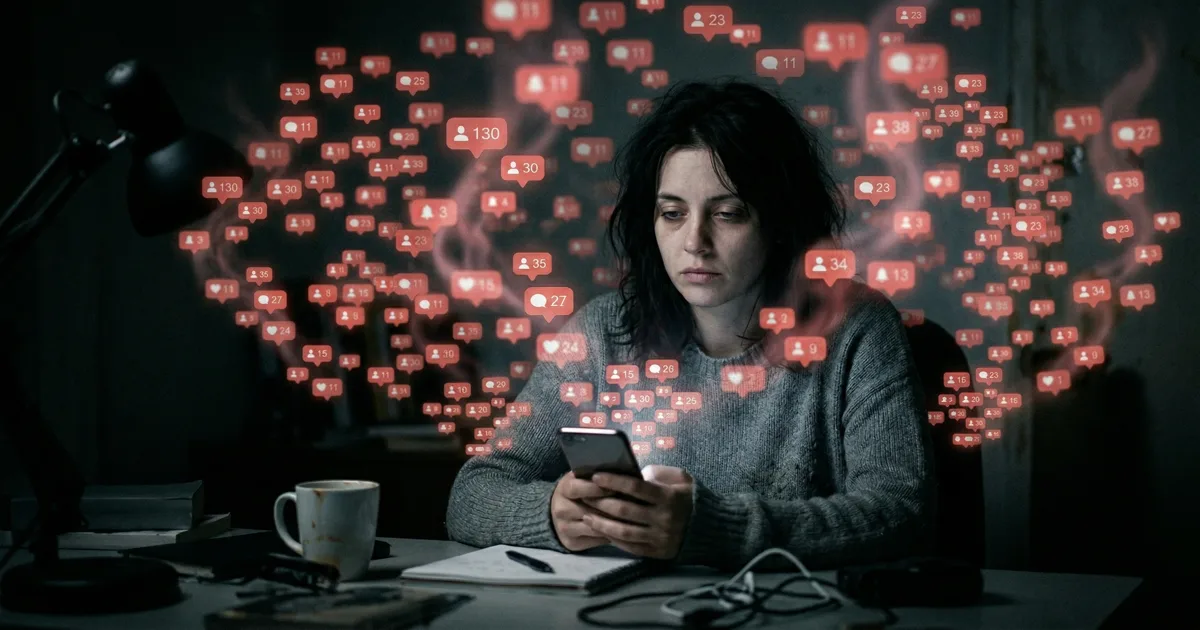
Those notification badges – the little red circles of new activity – aren’t really about keeping you informed. They create goals for you to accomplish where none existed before. A red dot is a call to action that’s hard to ignore. It plants a new to-do item in your head that sits there until you deal with it.
Facebook’s notification system isn’t a service it offers you. It’s a mechanism for pulling you back to the platform so that it can sell your attention to advertisers.
As Tim Wu, author of The Attention Merchants, puts it: we’re not paying for these services with money – we’re paying with our attention. And when you drift away – when you’re not feeding the machine with clicks, scrolls, and lingering glances – Facebook notices. The notifications become less about what’s actually happening in your world, and more about what might tempt you back.
The trouble is, when you barely use Facebook in the first place – or intentionally avoid spending much time on it, the algorithm doesn’t have much to work with. It doesn’t really know what you care about, because you haven’t shown it enough. So it guesses. It casts a wide net. It shows you strangers posting in groups, pages you’ve never interacted with, invitations to communities you’ve no reason to join.
Not because any of that is relevant to you. But because it might get you clicking.
The switch from social to surveillance
There’s a term for all of this: the attention economy. Platforms build interfaces designed to keep you around. Infinite scroll ensures there’s never a natural stopping point. Notifications play on the brain’s reward system, dangling the promise of something new.
What’s worth sitting with is how far this has drifted from what Facebook originally presented itself as. It used to be about connecting with people you knew. Updates from friends, events from local organisations, conversation between real people in real communities.
That original model – showing you content from people you actually know – has largely been replaced by something closer to a recommendation engine, showing you content an algorithm predicts you’ll engage with.
In plain terms: Facebook used to show you what your friends were doing. Now it shows you what will keep you on Facebook.
The notifications are a symptom of this. When I come back after a day away, what I get isn’t a digest of what mattered to my community while I was gone. What I get is a list of algorithmically chosen prompts designed to get me opening the app, clicking on something – anything – and staying there long enough to be served an advert.
Have you ever wondered why a product valued at some insane amount (trillion dollars or whatever) is given to us for free? You should.
What a low-use account reveals
I’d argue that people who barely use Facebook actually see the algorithm more clearly than heavy users do. If you spend hours on the platform every day, the algorithm gets to know your habits and builds a reasonable picture of what you respond to. It can virtually guess your thoughts about any post. The notifications feel more relevant because the machine has had more data to work with.
When you barely use it, the mask slips a bit. It gets confused and tries very hard.
The notifications that pile up in my absence don’t reflect my world at all – where’s the wildlife, the local community info worth reading, the posts from friends and local businesses? They reflect Facebook’s best guess at what might lure me back – and once you know what you’re looking at, they’re fairly transparent about it.
Which is why I’m ‘notified’ about groups I’ve never visited. Pages I’ve never followed. People I’ve never heard of.
That’s not my community. That’s not about keeping us connected. That’s an algorithm reaching into the dark and throwing things at the wall.
It’s probably not just Facebook
Facebook is the platform I know from direct experience, so it’s the one I’ve written about here. I don’t have the inclination – or frankly the time – to run the same experiment across every platform going.
But I’ve spent years reading the researchers, journalists, and digital rights advocates who investigate these things in depth, and the picture they consistently paint is that the architecture is much the same wherever you look.
LinkedIn, Instagram, TikTok, YouTube – different surfaces, different audiences, different content formats, but the same underlying engine: your attention is the product, and the notification system is one of the tools used to harvest it.
I may be wrong to assume they all operate this way. But I’d be surprised if I were.
So what do you do about it?
I’m not going to suggest you delete Facebook. Not my place to do that anyway. For a lot of people, particularly in local communities, it’s still a practical way to stay connected – to some extent. Local groups, events, small businesses – Facebook remains the town square for a lot of places, however imperfect that arrangement is.
But there’s a difference between using a platform and being used by one.
Turn off notifications that don’t serve you. The settings are there – most people just never touch them. Facebook gives you fairly detailed control over what triggers a notification and how it reaches you.
Strip out the noise and what’s left tends to be more useful.
Go in with a purpose. Post what you went to post, check what you went to check, and leave. You don’t have to follow the algorithm’s breadcrumb trail into groups you don’t care about and content you didn’t ask for.
And every now and then, look at that notification list after a day away from the platform. Ask yourself honestly: how much of it is actually relevant to your life?
The answer won’t tell you much about your community. But it’ll tell you plenty about whose interests Facebook’s notification system is really designed to serve.
The Bit They Don’t Put in the Help Centre
Why does Facebook notify me about people and groups I’ve never heard of?
Because the algorithm doesn’t have enough data on you to show you relevant content – so it guesses. When you’re a low-activity user, Facebook casts a wide net, surfacing strangers, obscure groups, and pages you’ve never visited in the hope that something gets you clicking. It’s not personalisation. It’s a best guess dressed up as one.
Are Facebook notifications designed to help me or to help Facebook?
Largely the latter. Notifications are engineered to pull you back to the platform when you’ve drifted away. The red badge creates a psychological prompt – a small sense of something unresolved – that’s hard to ignore. Once you’re back in the app, Facebook can serve you content and adverts. The notification is the hook. Your attention is what gets sold.
Does using Facebook less make the notifications worse?
In a sense, yes. The less you use the platform, the less the algorithm knows about you, and the less targeted its attempts to re-engage you become. Low-use accounts tend to get broader, less relevant notifications because the system is working with limited data. Ironically, the less you give Facebook to work with, the more clearly you can see what it’s actually doing.
Is this just a Facebook problem, or do other platforms do the same thing?
Most evidence points to it being widespread. The underlying business model – free platform, revenue from advertising, attention as the product – is common across Instagram, TikTok, LinkedIn, YouTube, and others. The specific mechanics differ, but the basic incentive is the same: keep you on the platform as long as possible, and use notifications as one of the tools to get you back when you leave.
Can I actually control what Facebook notifies me about?
Yes, more than most people realise. Facebook’s notification settings are fairly detailed – you can switch off alerts for group activity, page suggestions, people you may know, and a range of other triggers. Most users never touch these settings, which suits Facebook fine. Spending ten minutes in there can cut the noise significantly and leave you with notifications that are actually worth reading.