
Right, let’s cut through the greenwashing. You’ve been sold the idea that wind farms and solar panels will save the planet and lower your energy bills. Meanwhile, you’re paying some of the highest electricity prices in the developed world, your petrol costs more than nearly anywhere else, and billions of pounds are being funnelled into an industry with a dirty secret nobody wants to talk about. The misinformation about China “not having wind farms” might be bollocks, but it opened the door to something far more uncomfortable: the true cost of renewables, and who’s actually profiting from the climate panic.
China Dominates Wind Power, Not Us
Let’s start with the facts. China has over 570 GW of installed wind capacity – roughly twenty times what the UK has managed. They’re building wind farms at a scale that makes our offshore efforts look like a village fête. Six of the world’s top ten turbine manufacturers are Chinese, and they control 60–65% of global turbine production. When someone claims China “doesn’t do wind power,” they’re either woefully ignorant or deliberately misleading. China is the wind power superpower, both in deployment and manufacturing.
But here’s where it gets messy. Those turbines rely heavily on rare earth elements like neodymium and dysprosium for the powerful magnets inside. China controls over 80% of global rare earth processing. The environmental devastation caused by rare earth mining in Inner Mongolia and southern China includes toxic waste lakes, contaminated rivers, deforestation, soil erosion, and radioactive dust blowing across villages. Local farmers have been displaced, their land stripped bare, and the health impacts are staggering. This is the hidden environmental cost of every “green” turbine spinning in the UK.
Your Bills Are Paying for an Expensive Experiment
UK households now face the second-highest electricity prices globally, with industrial users paying the highest rates in the developed world – 63% more than France and 27% more than Germany. Domestic electricity bills are roughly double what Americans pay. Yet you’re told this is about “volatile gas prices.” That’s partially true, but it conveniently ignores the £220 billion in renewable subsidies paid out since 2002, currently adding about £280 per year directly to the average household bill, with hundreds more in indirect costs passed through food, goods, and services.
Energy economist Kathryn Porter has been sounding the alarm on this for years. In her 2025 report on the true affordability of net zero, Porter highlights how the UK’s renewable subsidies, grid upgrades, and constraint payments (paying wind farms to switch off when the grid can’t handle the power) are cumulatively hammering consumers. In 2024 alone, curtailment – paying wind farms not to generate – cost over £393 million, with forecasts suggesting this will hit £8 billion annually by 2030. You’re paying twice: once for the idle wind farm, and again for the gas plant that has to fire up in its place.
The Recycling Problem Nobody Wants to Mention
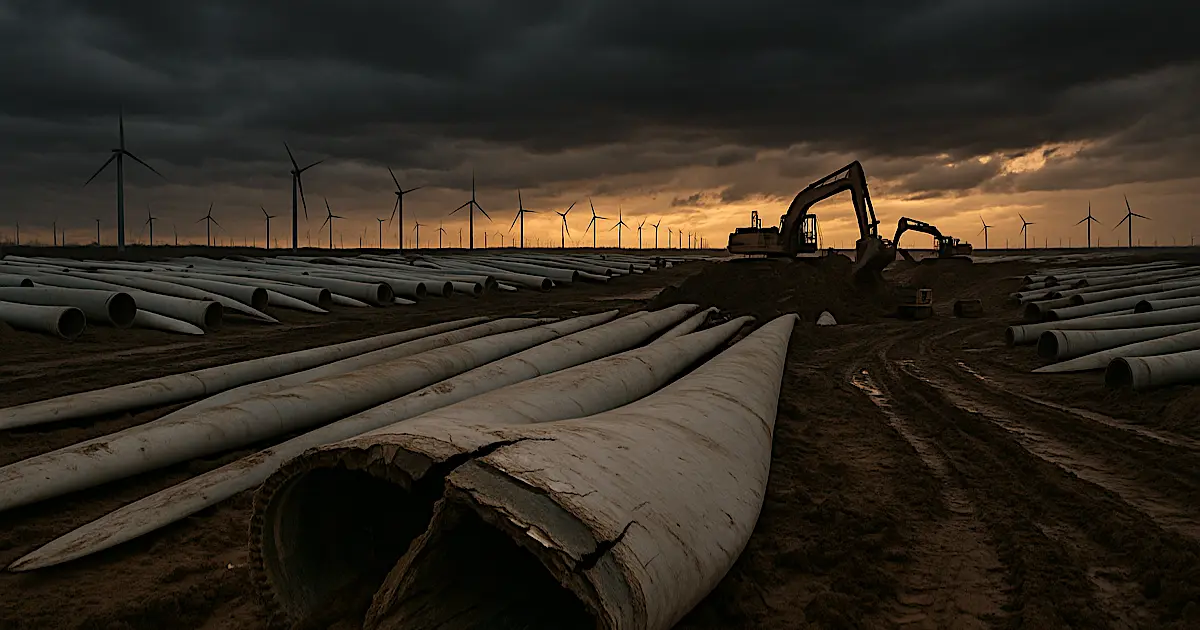
Wind turbine blades are made from composite materials – glass fibre or carbon fibre reinforced with resin – designed to be incredibly durable. That’s great when they’re spinning, but catastrophic when they reach end-of-life. Most recycling methods are either energy-intensive, produce low-value waste, or simply don’t exist at scale. Up to 78% of decommissioned blades in the US end up in landfills, and the UK faces a similar fate. Between 2025 and 2040, an estimated 10,000 to 20,000 blades will be decommissioned annually in the US alone, with Europe adding thousands more.
The industry promised circularity. What it’s delivering is landfills full of non-degradable composite waste that will sit there for centuries, potentially leaching chemicals into soil and groundwater. Some blades are incinerated, releasing carbon and other pollutants. The promised “green future” involves burying or burning millions of tonnes of toxic waste with no viable solution in sight.
Hidden Costs: Manufacturing, Transport, and Maintenance
Every wind turbine requires tonnes of steel, concrete, copper, aluminium, and rare earths. Manufacturing accounts for 63% of a turbine’s lifetime carbon emissions, with transportation adding another 14%. When components are shipped from China to European ports, transit emissions can be eleven times higher than sourcing locally. The construction phase disrupts peatlands and wetlands, releasing stored carbon, while offshore wind requires massive marine infrastructure and heavy fuel-burning cargo ships.
Maintenance isn’t cheap either – gearboxes need oil changes, parts need replacing, and all of it requires transport and labour. The operational carbon footprint might be low, but the total life-cycle cost – from mining raw materials to final disposal – is far higher than the sunny PR campaigns suggest.
Follow the Money
This isn’t about saving the planet. It’s about creating a multi-billion-pound industry that extracts wealth from consumers and funnels it to developers, manufacturers, and investors. Renewable energy companies are subsidised to build, subsidised to operate, and paid not to generate when the grid can’t cope. Meanwhile, ordinary people absorb the cost through inflated bills, higher food prices, and a general increase in the cost of living.
Kathryn Porter’s analysis makes it clear: renewables are not cheap when all system costs are included. The intermittency of wind and solar requires backup generation, grid stability measures, and expensive infrastructure upgrades. These costs don’t vanish – they’re passed directly to consumers, often hidden within “green levies” and other charges that few people understand.
The Uncomfortable Truth
Renewables have a role to play in energy diversification, but the current model is a wealth transfer mechanism dressed up as climate action. The environmental damage caused by mining, manufacturing, and disposal is conveniently exported to places like China, Myanmar, and Inner Mongolia, where regulations are lax and communities bear the brunt. Meanwhile, UK consumers are told to feel good about their rising bills because they’re “doing their bit” for the planet.
The misinformation about China and wind farms was false, but it revealed something more important: the entire renewable energy narrative is built on selective facts, hidden costs, and a refusal to confront the darker side of “green” technology. If we’re serious about addressing climate change, we need honesty about the true environmental and economic costs – not more greenwashing and subsidies for an industry that’s profiting while the rest of us pay the price.
Questions People Want Answered (But Rarely Get Straight Answers To)
Are Wind Turbines Recycled At The End Of Their Lifespan?
No, not in any meaningful way. Up to 78% of decommissioned turbine blades in the US end up in landfills or incineration because the composite materials (fibreglass and resin) resist recycling. The promised circular economy doesn’t exist yet, and millions of tonnes of blade waste are forecast to pile up over the next two decades with no viable solution in sight.
Why Are UK Electricity Bills So High If Renewables Are Cheap?
Because the true cost of renewables includes subsidies (around £280 per household annually), grid upgrades, constraint payments for wind farms that are paid to switch off, and backup generation when wind and solar aren’t producing. These “system costs” are hidden in green levies and feed directly into your bills, making UK electricity among the most expensive in the developed world.
Does China Control The Global Wind Turbine Supply Chain?
Absolutely. China dominates 60–65% of global turbine manufacturing, controls over 80% of rare earth processing (essential for turbine magnets), and operates the world’s largest wind capacity at over 570 GW. Every “green” turbine spinning globally is tied to Chinese supply chains, materials, and often manufacturing.
What Environmental Damage Does Rare Earth Mining Cause?
Rare earth mining, particularly in China and Myanmar, causes toxic waste lakes, radioactive dust, deforestation, soil erosion, and contaminated water supplies. Communities near mining sites face health problems, displacement, and destroyed farmland. This environmental destruction is conveniently ignored when touting the “clean” credentials of wind power.
Are Wind Farms Paid Not To Generate Electricity?
Yes, and it’s costing a fortune. When the grid can’t handle surplus wind power (often because infrastructure hasn’t kept up with turbine construction), operators are paid “constraint payments” to switch off. In 2024, this wasted wind cost £393 million, with forecasts suggesting it could hit £8 billion annually by 2030. You’re paying twice, once for idle turbines and again for gas plants that replace them.
How Long Do Wind Turbines Last And What Happens After?
Most turbines have a lifespan of 20–25 years before they need decommissioning or major refurbishment. When that time comes, the towers and nacelles can be dismantled and potentially recycled (steel, copper), but the blades are essentially un-recyclable with current technology. They’re either buried in landfill, ground into low-grade filler, or burned, none of which is remotely sustainable.
Who Profits From The Renewable Energy Industry?
Turbine manufacturers (mostly Chinese), developers, landowners receiving lease payments, and energy companies collecting subsidies and constraint payments. Meanwhile, consumers absorb the financial burden through higher bills, increased food costs, and a general rise in the cost of living, all while being told it’s necessary to “save the planet.”
Sources
Many sources were looked at during the creation of this summary article. Here they are:
China’s solar and onshore wind capacity reaches new heights while offshore wind shows promise
globalenergymonitor.org
China Accelerates Offshore Wind Growth as US Faces Headwinds
offshorewind.biz
China Energy Transition Review 2025
ember-energy.org
The ‘typhoon-proof’ wind farms powering China’s coast
bbc.com
Wind power in China
en.wikipedia.org
Explainer: China’s dominance in wind turbine manufacturing
reuters.com
Sourcing Critical Minerals for Solar and Wind Power
achilles.com
Chinese Manufacturers Lead Global Wind Turbine Installations
about.bnef.com
Top 15 wind turbine manufacturers in 2024
strategicenergy.eu
Material demand and recycling potential driven by wind power
sciencedirect.com
US and China provoke sharp fall in global outlook for renewable power
aljazeera.com
China leads global wind turbine manufacturers’ market
woodmac.com
OECD report highlights global disparity in wind energy support
windeurope.org
China Wind Power 2025
energyexport.dk
Wind turbines manufacturers from China
en.wind-turbine-models.com
Wind power and electrolysis: reduce reliance on China
tno.nl
The future of Chinese-made turbines in European Offshore Wind
wfw.com
Understanding the material efficiency of the wind power sector
sciencedirect.com
Securing Europe’s wind industry from dependence on China
ecfr.eu
Chinese wind turbine manufacturers dominate global market in 2024
windtech-international.com
A study on the environmental implications of raw materials
sciencedirect.com
Environmental impact of wind power
en.wikipedia.org
Mythbusting: Wind power is unreliable, inefficient and harmful to nature
statkraft.com
Wind energy and the environment
windeurope.org
Wind explained: Wind energy and the environment
eia.gov
The challenge associated with recycling wind turbine blades
allbase.co.uk
Quantifying logistics emissions in offshore wind
offshore-mag.com
Material consumption and environmental impact of wind turbines
sciencedirect.com
Reuse, recycling and disposal of wind turbine parts
delfos.energy
What is the Carbon Footprint of Offshore Wind?
orsted.com
Environmental Impacts of Wind Power
ucs.org
End-of-Life wind turbine blades: Review on recycling
sciencedirect.com
Carbon footprint of offshore wind farm components (pdf)
ore.catapult.org.uk
Advantages and Challenges of Wind Energy
energy.gov
No blade left behind: the wind sector’s commitment to sustainable blade solutions
windeurope.org
Life cycle assessment of wind farm
sciencedirect.com
How “Green” Wind and Solar Could Trash the Planet
energybadboys.substack.com
Can wind turbine blades be recycled?
nationalgrid.com
Life cycle costs and carbon emissions of wind power (pdf)
climatexchange.org.uk
Recycling and recovery of decommissioned wind turbines
slrconsulting.com
New report: The true affordability of net zero
watt-logic.com
The true affordability of net zero (PDF) (pdf)
watt-logic.com
Net Zero’s Impact on the UK Energy Landscape
clintel.org
Kathryn Porter: The true affordability of net zero
notalotofpeopleknowthat.wordpress.com
Renewables are not cheap, says Kathryn Porter
linkedin.com
UK Renewable Electricity Subsidy Totals: 2002 to the present day
ref.org.uk
Discarded wind energy increases by 91% in 2024
ref.org.uk
Kathryn Porter – New report: The true affordability of net zero
linkedin.com
Net zero subsidies cost British households £280 a year
telegraph.co.uk
Wasted wind power adds £40 to household energy costs
bbc.co.uk
New report: The true affordability of net zero (Energy News Beat)
energynewsbeat.co
Renewable Energy in the UK
eciu.net
Net zero’s dirty secret risks costing Britain billions
telegraph.co.uk
“Renewables are self-evidently not cheap” – Kathryn Porter
youtube.com
Tories pledge to cut bills as energy price battle takes shape
bbc.co.uk
The Hidden Cost of “Wasted” Wind Power
gleg.co.uk
Why an energy system dominated by renewables remains the lowest cost for billpayers
renewableuk.com
As wasted wind is set to hit £650m so far this year
octopus.energy
The price of energy and the system costs of renewables
dieterhelm.co.uk
Analysis: Growth in British renewables cutting electricity prices by up to a quarter
eciu.net
Global household electricity prices 2025, by country
statista.com
Britain paying highest electricity prices in the world as net zero costs rise
telegraph.co.uk
International energy price comparison statistics
gov.uk
How Do UK Energy Prices Compare Globally?
expertelectrical.co.uk
Why expensive gas not net-zero is keeping UK electricity prices so high
carbonbrief.org
GE sues company for failure to recycle turbine blades
energywatch.com
China Has Paid a High Price for Its Dominance in Rare Earths
nytimes.com
UK Industrial Electricity Prices Still Highest in Europe
davidturver.substack.com
How Innovators Are Solving the Wind Industry’s Recycling Problem
triplepundit.com
The price of the rare earth metals the world buys from China
bbc.co.uk
Why Are Energy Bills Still So High In 2025?
bpconsulting.co.uk
Wind turbine blades: inside the battle to overcome their waste problem
theconversation.com
China Wrestles with the Toxic Aftermath of Rare Earth Mining
e360.yale.edu
International energy prices: comment
eciu.net
End-of-life wind turbine blades and paths to a circular economy
sciencedirect.com
Myanmar’s poisoned mountains
globalwitness.org
Geochemical behavior of rare earth elements in mining environments
sciencedirect.com
Not So “Green” Technology: The Complicated Legacy of Rare Earth Mining
hir.harvard.edu