
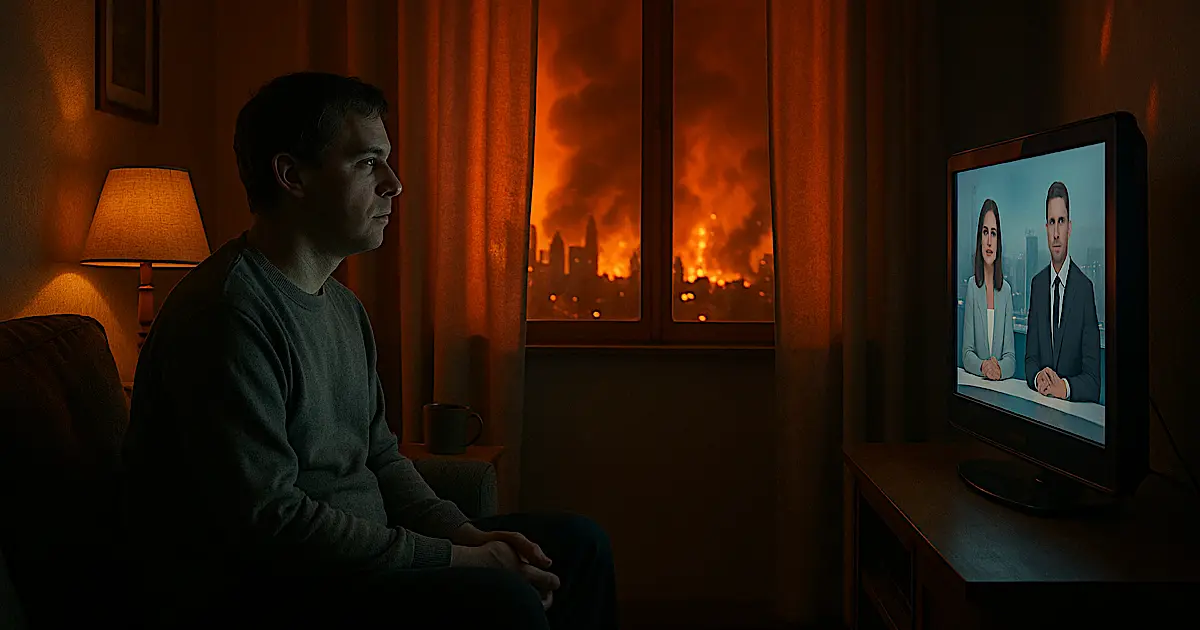
Trying to help people understand what’s really going on feels like running back into a burning building to drag them out. But they’re standing there with a brew, watching the blaze on telly, saying, “It’s fine, love – the experts said it’s under control.”
You point at the flames, you tell them the roof’s caving in, and they still want “evidence” that it’s hot. That’s how deep this thing goes – we’ve built a world where people trust the screen more than their own senses.
The News Isn’t There to Warn You
People like to believe the news is some noble truth-telling institution. It isn’t. News is a business – a BIG business. A ratings-driven, emotionally-engineered, narrative-shaping machine.
I’m not saying all journalists are corrupt. There are good ones (rare) – proper reporters who risk their necks for truth. But they’re not the ones reading scripts between adverts for fast-food, the next bright ‘n’ shiny gadgets and car insurance. The issue isn’t the reporter; it’s the newsroom. The owners, the sponsors, the political connections, the approved narrative and the invisible hand that decides what’s worth knowing and what’s better left buried.
And yet, people cling to it because it feels safe. According to the 2024 Edelman Trust Barometer, over 60% of people globally don’t trust the media but most still watch it daily (face palm). That tells you everything. They don’t tune in for facts. They tune in for reassurance.
“Surely you’re being too harsh,” some will say. “We need the media to keep us informed.” Maybe. But informed about what? You’re not getting a window to the world. You’re getting a pre-edited movie about it.
The Script Is Written Long Before You Hear the Story
Most of what passes for “news” now isn’t false – it’s framed. Real footage, real events, told with selective context to make you feel a certain way. It’s not the facts that are wrong. It’s the emotional manipulation around them.
You can almost hear the editorial meetings: “What will make people angry today? What will keep them glued for the next segment?”
It used to be “if it bleeds, it leads.” Now it’s “if it divides, it thrives.”
And yes, bias has always existed. Newspapers in the 1800s were as partisan as anything today. But the difference now is scale. The bias isn’t in one paper or channel. Now it’s across the entire information stream. It’s slick, coordinated, and repetitive enough to make even the sane start doubting their senses.
And driven by those damn algorithms!
Social Media Isn’t the Cure – It’s the Steroids
A lot of people like to say, “I don’t watch the news anymore, I get my information online.” Great, so instead of being manipulated by journalists, you’re being manipulated by algorithms.
Social media doesn’t care what’s true. It cares what keeps you scrolling. That’s their job! Anger, fear, envy – those are engagement goldmines. The Wall Street Journal’s Facebook Files showed that posts that made people angry spread six times faster than positive ones. Twitter (sorry, I mean ‘X’) admitted the same thing: its algorithm boosts outrage because outrage keeps you logged in.
So what you end up with is not “your feed” – it’s your reflection. An echo chamber where your opinions come back to you louder, angrier, and less open to reason. You stop seeing the world; you start seeing your own bias on a loop.
Now, people will argue, “You can’t trust everything online either.” Exactly. That’s the point. You can’t trust any of it if you stop thinking for yourself. Both mainstream media and social platforms play the same game: keep you emotional, not rational.
Denial Is Easier Than Admitting You’ve Been Played
I don’t think people are stupid (well, some are). Far from it. I think most people are just tired – mentally, emotionally, economically. They don’t have the bandwidth to question everything.
It’s not that they don’t notice the contradictions or the hypocrisy. They do. But acknowledging it means facing the fact they’ve been lied to, sold to, and manipulated for decades. And that’s terrifying.
So they stay inside the burning building, telling themselves it’s not that bad. Because admitting the truth would mean stepping out into uncertainty. And people would rather be wrong and comfortable than right and terrified.
And no, that’s not “looking down on ordinary people.” It’s empathy. Genuine empathy. The system relies on exhaustion, not ignorance. People are overwhelmed, not oblivious. That’s why they fall for the lullaby.
Entertainment Disguised as Empathy
Daytime television and “soft news” are masters of the illusion. Heartfelt human-interest stories, emotional interviews, celebrity tears – all designed to keep you feeling rather than thinking.
These shows don’t exist to make the world better. They exist to keep viewers docile and to bring in the big cash from sponsors. To make people feel “connected” while their real-world frustrations are quietly redirected into sympathy for causes that pose no threat to the system.
Someone will say, “You’re fuelling division by saying this.” Maybe. But I’d rather divide truth from bullshit than pretend we’re all on the same page while we’re being fed lies.
Not Everyone Can Be Saved
This is the brutal part. Some people don’t want to wake up. They like the warmth of the fire. They like believing someone else has it all under control.
You can show them evidence, contradictions, leaked documents, data, sit them face to face with a whistle-blower for a few hours – doesn’t matter. They’ll still default to, “Well, the news said…” because that’s easier than rewriting their entire worldview.
And yes, it’s easy to sound bitter about it. But it’s not bitterness. It’s sadness. Sadness that people have become so used to manipulation that truth now feels like aggression.
Am I just moaning? Maybe. But sometimes moaning’s the only way to stay sane.
The Way Out
So what do you do when you can’t save everyone? You stop trying to. You stop running back into the fire ya daft sod you’re gonna get burned (or is it ‘burnt’).
- Start building somewhere else – away from the noise, the outrage, the constant manipulation.
- Read widely.
- Question calmly.
- Support independent journalism that shows its sources, not the ones that say “trust us.”
- Follow people who admit when they’re wrong.
And most importantly, learn to sit with not knowing. That’s the bit we’ve lost. The ability to say, “I don’t have the full picture yet,” without feeling stupid or disloyal.
Because once you can admit that, you’ve already escaped the fire.
Questions People Ask While the Building Burns
Is the Media Really Manipulating What We Think?
Yes, but not always through lies. Most manipulation happens through selective framing, emotional triggers, and omission. The story is shaped to make you feel something specific, not necessarily to help you understand it.
How Does Social Media Make This Problem Worse?
Algorithms reward strong emotions because outrage keeps people scrolling. As a result, angry and divisive content spreads faster than balanced information, creating echo chambers that reinforce what we already believe.
Are All Journalists Part of the Problem?
No. Many journalists genuinely care about truth, but their work is filtered through corporate or political agendas. The issue lies in editorial control and ownership, not every individual reporter.
Why Do People Still Trust the News If They Know It’s Biased?
Because trust feels safer than uncertainty. People want stability and reassurance, and the news provides a comforting illusion of control, even when the facts are selective.
Can Social Media Ever Be Trusted for Real Information?
It can, but only if you treat it as a source of clues, not conclusions. Follow independent voices, verify claims, and assume every viral story has been shaped to get a reaction.
What Can We Do to Protect Ourselves from Media Manipulation?
Read widely, question everything, and stay calm before sharing or reacting. Awareness is the first defence, and curiosity is the best antidote to control.
Why Does It Feel Like Truth Is Getting Harder to Find?
Because there’s more noise than ever before. Between traditional propaganda and digital chaos, the real challenge now isn’t access to information, it’s learning how to recognise what’s genuine.
Sources used for this article
Edelman Trust Barometer 2024
edelman.com
The Facebook Files – The Wall Street Journal
wsj.com (Wall Street Journal)
Twitter’s Algorithmic Amplification Research (2021)
blog.twitter.com
Reuters Institute Digital News Report 2024
reutersinstitute.politics.ox.ac.uk
Ofcom News Consumption in the UK 2023
ofcom.org.uk
Pew Research Center – The State of News Media 2023
pewresearch.org