
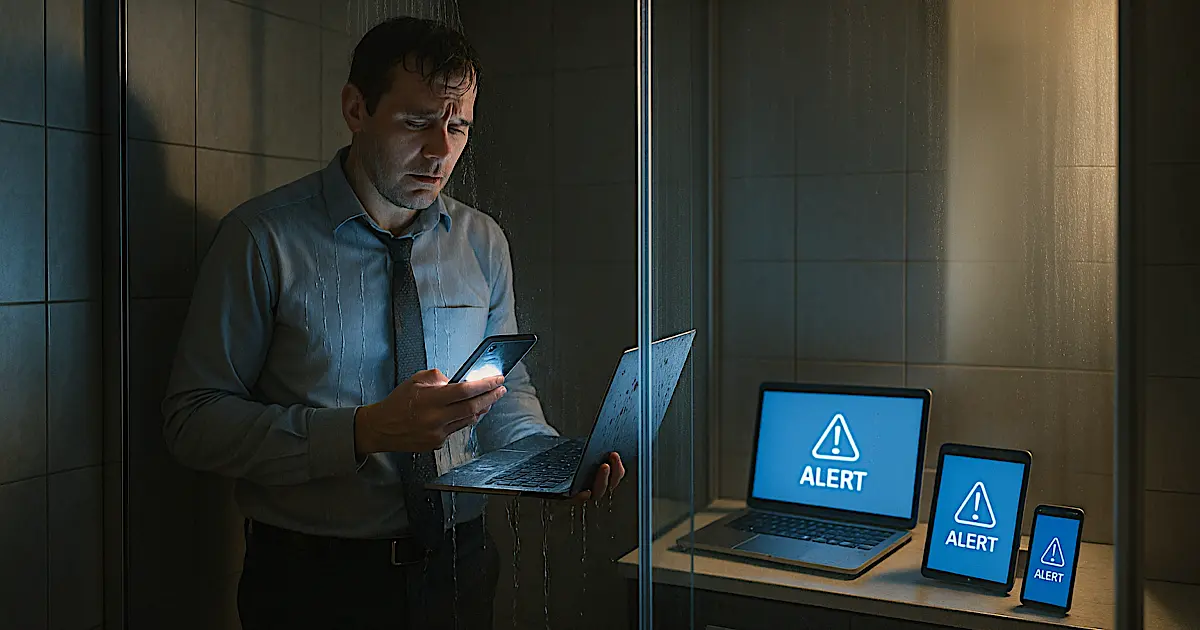
I was typing this article when I decided to take a shower. Before I’d even dried off properly, I was back at the keyboard, fingers tapping away. If that’s multitasking, then I’m the bloody Queen of England.
In Summary:
Attention Deficit Trait isn’t something you’re born with. It’s what happens when your work environment overwhelms your brain’s natural capacity to focus, plan, and think clearly. Modern workplace culture, with its constant notifications, always-on expectations, and relentless multitasking demands, creates cognitive overload that makes you less productive, more stressed, and prone to mistakes. The symptoms, difficulty concentrating, restlessness, and poor decision-making, are reversible once you change how you work.
Multitasking is a myth. Your brain doesn’t do two things simultaneously. It switches between tasks, and every switch costs you focus and time. Research shows multitasking can reduce productivity by 40% and increase errors by 20%. When you check your phone during meetings or respond to emails whilst writing reports, you’re not being efficient. You’re fragmenting your attention and exhausting your brain for minimal gain. The feeling of productivity whilst multitasking is exactly that, just a feeling.
Twenty-five years ago, work stayed at work. Physical boundaries between office and home created natural buffers that protected your downtime. Remote work and constant connectivity have obliterated those boundaries, leaving you perpetually available and never fully switched off. The result is chronic stress, burnout, and deteriorating mental health for millions of workers who’ve been told this is normal.
Fixing ADT requires deliberate changes: protect your sleep, turn off notifications, batch similar tasks together, set hard boundaries, and stop treating your inbox like a to-do list. Your brain needs rest, focus, and downtime to function properly. The modern workplace is designed to prevent all three. Reclaiming your cognitive capacity isn’t about working harder. It’s about refusing to let broken systems break you.
It Isn’t Multitasking. It Never Was.
What happened in that shower is what happens when your brain finally gets a moment to breathe without notifications pinging, emails flooding in, and messages demanding immediate responses. Your subconscious keeps working on the problem whilst your conscious mind is occupied with mundane tasks like washing your hair.
That’s not juggling multiple tasks simultaneously. That’s your brain doing what it’s designed to do when you stop throttling it with constant distraction.
We’ve convinced ourselves that staying connected, responsive, and “always on” makes us more productive. Research from Stanford University shows multitasking can drop productivity by as much as 40%. Workers who multitask take 20% longer to complete tasks and make more errors. Yet here we are, proud of our ability to answer emails whilst on video calls, checking our phones during meetings, and calling it efficiency.
Twenty-five years ago, you went to work, did your job, and came home. Work stayed at work. Life happened outside the office. Breakfast was at home, not scarfed down at your desk between meetings. When you left the building, work didn’t follow you into the pub, onto the sofa, or into bed. Even workaholics eventually went home and switched off. Now? Everything follows us everywhere. Your boss can reach you at 10pm. Clients expect responses on weekends. Colleagues message you whilst you’re on holiday because “it’ll only take a minute.”
This isn’t progress. It’s Attention Deficit Trait, and it’s making us stupider.
What ADT Actually Is
Attention Deficit Trait (sounds a bit like ADHD doesn’t it?) isn’t something you’re born with. It’s what happens when your environment overwhelms your brain’s natural capacity to process information, plan effectively, and sustain focus. Dr. Edward Hallowell (he of ADHD fame), who coined the term, describes it as a neurological response to chronic overload.
Put simply: Your executive functions, normally responsible for clarity and creativity, just seize up under pressure.
The symptoms read like a checklist for modern office life:
- difficulty concentrating,
- restlessness,
- inability to prioritise,
- impulsiveness,
- diminished decision-making ability.
People with ADT spend longer at their desks yet make more mistakes. Their creativity wanes. Problem-solving becomes harder. They’re stuck in a cycle of busyness that produces sod all of actual value.
Here’s what matters: ADT is reversible. It’s not hardwired into your DNA. It’s caused by the environment you’re working in, which means changing that environment can fix it. But first, you have to admit the current system is broken, and most companies would rather pretend it’s fine whilst their staff burn out quietly.
The Boundaries That Used To Exist
In the 90s (and before then too – the world was so lovely and calm), work-life balance meant separating your professional and personal lives. Not metaphorically. Physically. You showed up to an office, did your work during set hours, and when you went home, work stayed behind. The average working week dropped to 35 to 40 hours, and when those hours ended, they actually ended. Your boss couldn’t ring you at home because most people didn’t have mobiles, and even if they did, calling someone outside work hours was considered bloody rude.
Remote work hasn’t created flexibility for most people. It’s obliterated boundaries.
The physical separation that offices provided, those natural buffers like cycling home or reading on the train, they’re gone. Pre-pandemic workers had routines that allowed them to transition between roles: worker to parent, professional to human. Now you roll out of bed, open your laptop, check your phone, and you’re immediately at work – but you’re not. Eight hours later, you close the laptop, but your brain is still there. The notifications keep coming.
The work keeps piling up.
You never actually leave.
Global teams and time zones make this worse. Someone’s always online, which means you feel pressure to be online too. Around-the-clock productivity isn’t a badge of honour. It’s a trap.
And yes, some jobs genuinely require availability. Emergency services, healthcare, certain client-facing roles (when you’re the boss or run your own business). But most knowledge work doesn’t. The “urgent” tasks filling your inbox aren’t emergencies. They’re manufactured urgency, designed to keep you responding, reacting, and perpetually engaged.
Multitasking – The Myth Everyone Still Believes
Your brain can’t do two things at once. It switches between tasks, and every switch costs you. Studies show that brief task switches can consume up to 40% of your productive time. The American Psychological Association found that 49% of workers report feeling burned out specifically because of the sheer volume of tasks they’re trying to juggle simultaneously.
When you “multitask,” what you’re actually doing is fragmenting your attention into worthless slivers. Each time you switch from writing a report to checking your phone to responding to a message, your brain incurs a switching cost. Neither task gets done efficiently. Both suffer. You end up working longer hours to accomplish less, and you feel exhausted because your brain has been in constant gear without ever actually moving forward.
Some people will argue that multitasking works for them. Research shows people with higher working memory capacity can handle task switching more effectively, but that doesn’t mean they’re doing two things simultaneously. They’re just better at recovering from the switching cost. And even they perform worse than they would if they’d focused on one task at a time.
The “feeling” of productivity whilst multitasking is the problem. You feel busy. You feel engaged. You feel like you’re getting things done. But objective performance drops, errors increase, and quality suffers. That disconnect between how productive you feel and how productive you actually are should alarm you, not reassure you.
What Happens in the Shower
More than 70% of people across eight countries surveyed (no the researcher wasn’t in the shower with the subjects) report getting creative ideas in the shower. That’s not coincidence. It’s neuroscience. When you step into the shower, your brain’s default mode network activates. This system connects more than a dozen regions of the brain and becomes more active during passive tasks than when you’re focused on demanding work.
The shower provides what modern work environments deliberately deny you:
- solitude,
- tranquillity, and
- freedom from interruptions.
Warm water relaxes you. Your brain releases dopamine, which enhances mood and cognitive function. You’re in the perfect state for divergent thinking, the ability to generate multiple solutions to problems. Your subconscious, which has been churning away on problems you were too busy to consciously solve, suddenly surfaces insights into your conscious mind.
This is why stepping away from demanding work isn’t procrastination. It’s essential brain function. Your default mode network doesn’t switch off when you’re not actively working. It does the heavy lifting whilst your conscious mind takes a breather. But you can’t access that if you’re constantly engaged. If you’re checking emails between showers, scrolling social media during lunch, and answering messages until you fall asleep, your brain never gets the downtime it needs to actually think.
The Cost Nobody Talks About
Knowledge workers are exposed to more than 30 gigabytes of information every day. The constant ping of emails, chat apps, and meeting notifications ensures your attention is perpetually fragmented. Remote work blurs boundaries between professional and personal life, and without the physical separation an office provides, switching off becomes nearly impossible.
The psychological impact is measurable. Workers who experience blurred work-life boundaries report deteriorating mental health, reduced happiness, and lower life satisfaction. When work spills into personal time, you have limited opportunities to engage in self-care, pursue hobbies, or spend quality time with loved ones. That erodes your wellbeing and adds to burnout.
Employers pay a cost too. Work-life balance conflict affects businesses through higher absenteeism, reduced productivity, decreased job satisfaction, lower commitment and loyalty, and rising healthcare costs. Yet many companies continue to reward “always on” behaviour whilst claiming to care about employee wellbeing. They offer flexible schedules and mental health apps whilst simultaneously expecting you to respond to emails at 9pm and join calls during your holiday.
Some people prefer flexibility.
- Parents,
- carers,
- neurodivergent individuals,
- those with chronic conditions.
The ability to work outside rigid 9-to-5 hours can be liberating. But there’s a difference between flexibility as autonomy (you control when you work within boundaries you set) and flexibility as exploitation (you’re expected to be available whenever it suits your employer). Most companies offer the latter whilst pretending it’s the former.
What Actually Works
You can reverse ADT, but it requires changes most people won’t make because they’ve been conditioned to believe busyness equals value. Your brain needs physical support: adequate sleep, whole foods, regular exercise. One minute of mindful breathing after every activity reduces stress hormones. A short brisk walk in the middle of your day resets your brain’s ability to focus.
Schedule your most important work for when your mind is sharpest. For most people, that’s early in the day. Group similar tasks together to reduce switching costs. Use the OHIO rule for emails: Only Handle It Once. When you touch something, act on it, file it, or discard it. Stop treating your inbox like a to-do list. If something’s older than 30 days and still sitting there, archive it. You can search archived emails if needed, which almost never happens.
Turn off notifications. Actually turn them off, not just during “focus time” you schedule between meetings. Most messages don’t require immediate responses, but your brain treats every notification like an emergency. That constant state of alertness exhausts you. Set specific times for processing email and messages rather than letting them interrupt throughout the day.
Create hard boundaries and communicate them. Identify what you need to protect: not working overtime, keeping weekends sacred, maintaining lunch breaks. Specify where the line is. Predetermine your actions when boundaries are crossed. Then tell people about them. You’re not being difficult. You’re being sustainable. Companies that respect boundaries retain better staff and get higher quality work.
The Complications
Some jobs genuinely require availability. Surgeons on call. Global team leads managing time zones. Client-facing roles with international customers. These aren’t excuses. They’re operational realities. But even in high-availability roles, strategic rest produces better results than grinding to burnout. A surgeon who’s slept properly makes fewer mistakes. A team lead who protects their downtime makes clearer decisions.
Startups and small businesses face different pressures. Extended hours are often necessary for survival. But there’s a difference between strategic intensity during critical periods and permanent crisis mode. If your startup is always in crisis, you’ve got a business problem, not a work ethic problem.
Individual responsibility exists. Some people genuinely can’t say no, even when their workload is manageable. Some check emails compulsively even when nobody’s asking them to. That’s worth examining. But individual failures don’t absolve systems deliberately designed for addiction and constant engagement. Social media platforms, chat apps, even email interfaces are built to keep you hooked. Blaming individuals for succumbing to environments engineered for exploitation is lazy thinking.
What This Means
Your brain is a finite resource. Treating it like an always-on machine doesn’t make you productive. It makes you mediocre. You can check 800 emails, attend six meetings, and respond to 40 Slack messages in a day, and still accomplish nothing of value.
Busyness isn’t achievement. It’s often avoidance disguised as work.
The modern workplace is designed to create ADT. Open plan offices with constant noise. Chat apps demanding instant responses. Meeting culture that eats entire days. Email volumes that would’ve been unthinkable 25 years ago. Remote work that follows you into your bedroom. None of this happened by accident. It happened because companies prioritised the appearance of productivity over actual results, and workers went along with it because they were afraid of being seen as uncommitted.
You’re not going to fix this by downloading another productivity app. You fix it by
- reclaiming boundaries,
- protecting your attention, and
- accepting that multitasking is bollocks.
Your brain works best when it’s allowed to focus on one thing, rest properly, and process information without constant interruption. Everything else is theatre.
The Bits Nobody Tells You About ADT
Can ADT Be Cured Permanently or Does It Keep Coming Back?
ADT is reversible because it’s caused by your environment, not your genetics. However, if you return to the same overloaded work environment without maintaining boundaries, the symptoms will return. It requires ongoing commitment to protecting your attention and managing your workload.
Is Checking My Phone During Meetings Really That Harmful to Productivity?
Absolutely. Every time you switch tasks, your brain needs up to 23 minutes to fully refocus. Even glancing at your phone fragments your attention and increases the cognitive load on your brain. You’re not multitasking, you’re just doing both things poorly whilst exhausting yourself faster.
How Do I Explain Boundaries to My Boss Without Sounding Uncommitted?
Frame boundaries around results, not effort. Explain that protecting focus time produces higher quality work and fewer errors. Most reasonable managers value sustainable performance over performative busyness. If your boss punishes you for setting healthy boundaries, you’re working for the wrong person.
What If My Job Genuinely Requires Me to Be Available Outside Normal Hours?
Some roles genuinely need availability, particularly in healthcare, emergency services, or global teams. The key is distinguishing between genuine operational needs and manufactured urgency. Even high-availability roles benefit from protected downtime and strategic rest periods. Constant crisis mode suggests a business problem, not a dedication problem.
Can Some People Actually Multitask Effectively?
No. What varies is how quickly people recover from task switching. Research shows people with higher working memory capacity handle switching better, but they still perform worse than if they’d focused on one task. The feeling of being good at multitasking is exactly that, just a feeling.
Is Remote Work Making ADT Worse or Better?
Remote work eliminates physical boundaries that naturally separated work from home. Without commutes or office structures, many people find it harder to switch off. However, remote work can reduce some distractions like open plan office noise. The key is deliberately creating boundaries that office life used to provide automatically.
How Long Does It Take to Reverse ADT Symptoms Once I Start Making Changes?
Most people notice improvements within a few weeks of implementing proper sleep, boundaries, and focused work practices. Your brain responds quickly to reduced cognitive load. However, sustaining those improvements requires permanent changes to how you work, not just a temporary detox.
Sources
Every source listed here has been checked for credibility with my best intentions and abilities – author qualifications, organisational reputation, publication standards, and whether claims are actually backed by evidence.
I’ve prioritised official sources, established research, and recognised experts over random blogs and commercial and clickbait nonsense.
But here’s the reality (disclaimer): I can’t control what happens on those external sites after I’ve published this. Content changes, pages vanish, organisations update their positions. So whilst I’ve done the legwork to ensure these sources were solid when I mentioned (cited) them, if you’re making significant decisions, verify the current information yourself or talk to someone qualified.
Primary Research and Academic Studies
Cognitive Control in Media Multitaskers
pmc.ncbi.nlm.nih.gov
Media Multitaskers Pay Mental Price, Stanford Study Shows
news.stanford.edu
Heavy Multitaskers Have Reduced Memory, Stanford Research
news.stanford.edu
Overloaded Circuits: Why Smart People Underperform
hbr.org
Multicosts of Multitasking
pmc.ncbi.nlm.nih.gov
Why Do We Need Media Multitasking? A Self-Regulatory Perspective
pmc.ncbi.nlm.nih.gov
Not Able to Lead a Healthy Life When You Need It the Most: Work-Life Boundaries Research
pmc.ncbi.nlm.nih.gov
The Dual Impact of Digital Connectivity: Balancing Productivity and Wellbeing
pmc.ncbi.nlm.nih.gov
Remote, Disconnected, or Detached? Examining the Effects of Technology Use
pmc.ncbi.nlm.nih.gov
Creativity: The Unconscious Foundations of the Incubation Period
pmc.ncbi.nlm.nih.gov
Why and When Does Multitasking Impair Flow and Subjective Wellbeing?
pmc.ncbi.nlm.nih.gov
Working Memory Capacity Predicts Effective Multitasking
sciencedirect.com
Work-Life Balance in Great Companies and Pending Issues
pmc.ncbi.nlm.nih.gov
Professional and Expert Resources
Multitasking: Switching Costs
apa.org
2024 Work in America Survey (pdf)
apa.org
Burnout and Stress Are Everywhere
apa.org
2023 Work in America Survey: Workplaces as Engines of Wellbeing
apa.org
ATD: Attention Deficit Trait
morassociates.com
Understanding Attention Deficit Trait (ADT)
laboradvisors.com
What Is Attention Deficit Trait?
unrubble.com
Setting Healthy Boundaries at Work
workplacestrategiesformentalhealth.com
Established Publications and Analysis
Why You May Do Your Best Thinking in the Shower
psychologytoday.com
Why You Get Your Best Ideas in the Shower
time.com
Science-Based Shower Routine Could Boost Creativity
as.virginia.edu
A New Way to Navigate Work and Life
bbc.com
How an ‘Always-On’ Work Culture Can Create a Vicious Cycle
theconversation.com
The Hidden Cost of Task Switching (And How to Beat It)
close.com
Stop Overloading the Wrong Part of Your Brain at Work
hbr.org
How to Combat an “Always On” Work Culture
knowledge.insead.edu
What PwC Learned from Its Policy of Flexible Work for Everyone
hbr.org
The 24-Hour Work Cycle: Navigating “Always On” Culture
worklife.vc
Workplace Research and Resources
How Blurred Boundaries Between Work and Personal Life Contribute to Employee Burnout
greatplacetowork.in
The Impact of Remote Work on Work-Life Boundaries
enhancedpotential.com.au
Assessing the People Cost of an “Always-On” Work Culture
blog.perceptyx.com
Evolution of the Workplace Through the Decades
hrme.economictimes.indiatimes.com
Origins and Evolution of Work-Life Balance: A Historical Perspective
lifeuno.com
Work-Life Balance in the United States
en.wikipedia.org
Managing the ‘Always On’ Culture: Setting Boundaries in Remote Work
linkedin.com
Four Ways to Help Employees Manage ‘Always On’ Culture
ap.themyersbriggs.com
Productivity and Email Management
The Myth of Multitasking: Research-Backed Reasons to Simplify Your Work Approach
whitakertraining.co.uk
Using The Inbox Zero Method To Stay Digitally Organized
clean.email
How to Manage Your Inbox: Complete Organization Guide
getinboxzero.com
5 Steps to Process a Backlog of Emails
linkedin.com
The Ultimate Guide to Email Management Best Practices at Work
maestrolabs.com
How to Mass Delete Emails on Gmail
zapier.com