
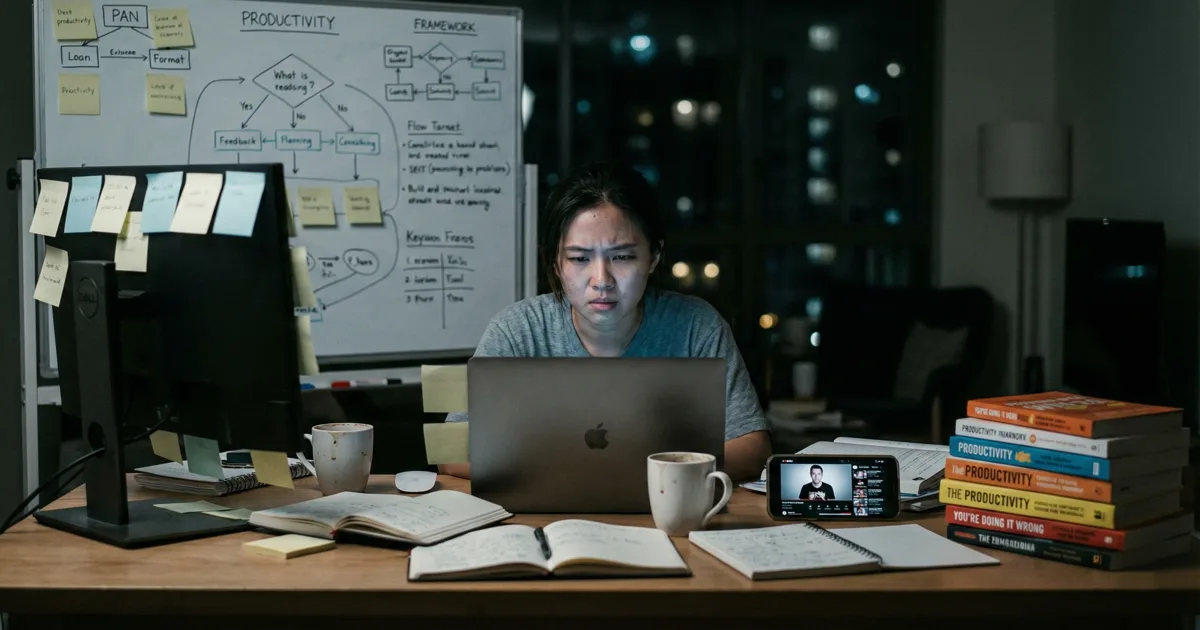
YouTube hasn’t just become a place to learn how to do things. It’s become a place where you’re constantly told that whatever you’re already doing is wrong, inefficient, amateurish, or quietly sabotaging your future.
Not bad enough to stop, obviously. Just bad enough to make you feel uneasy. That low-grade itch of “I probably should sort this out properly at some point”.
And once that itch is there, the solution is always conveniently close. A better system. A smarter workflow. A “game-changer”. A free PDF that isn’t really free because it leads to a funnel, which leads to a course, which leads to a VIP community, which leads to a monthly subscription you forgot you signed up for while watching a video about how to simplify your life.
Oh, the irony.
The Genius of Manufactured Doubt
The genius of it is that it dresses itself up as help. Productivity. Optimisation. Self-improvement.
Who could argue with that? Who wouldn’t want to be more productive, more optimised and improved?
But scratch the surface and most of it isn’t about making your life better at all. It’s about creating just enough doubt that you’ll
- keep watching,
- keep comparing,
- keep feeling one step behind.
Because the moment you feel “sorted”, the algorithm loses you.
So you end up second-guessing everything.
Your notes app isn’t a notes app anymore, it’s a personal knowledge management system you’re apparently misusing.
Your calendar isn’t a calendar, it’s a failure of time-blocking discipline.
Your reminders aren’t reminders, they’re proof you haven’t discovered the right framework yet.
Even brushing your teeth turns into a biohacking opportunity if you scroll long enough.
The People Selling the Cure
And the punchline is this: most of the people telling you you’re doing it wrong aren’t living calmer, simpler, more grounded lives. They’re living inside the same churn, just monetising it better.
Not every productivity YouTuber is running a con. Some genuinely share systems that work for them, no upsell attached.
The problem isn’t always the advice itself. It’s that we’ve collectively developed this weird parasocial relationship where we feel obligated to adopt someone else’s entire life instead of just nicking the one useful bit and moving on.
But those honest creators? They’re not the ones the algorithm rewards. The ones getting pushed to the top are the ones who’ve figured out that manufactured anxiety keeps people watching. That feeling slightly inadequate drives more engagement than feeling capable ever will.
Who Really Keeps Coming Back
And here’s the bit that stops being funny. The people most vulnerable to this aren’t the casually curious. It’s those already carrying self-doubt like a second skin, constantly questioning how they perform, how they come across, whether they’re doing enough.
Anyone dealing with anxiety, isolation, or the weight of unresolved trauma finds themselves trapped in this loop, believing the answer to everything is out there somewhere, just three more videos away.
They keep coming back for strangers who’ve never met them to explain how to live better, work smarter, feel less broken. Because when you’re stuck in that headspace, the idea that someone else has cracked the code feels like hope. And hope, even false hope, is hard to walk away from when you’re struggling.
The Endless Optimisation Theatre
Funny old place, YouTube. A bottomless pit of advice that somehow leaves everyone feeling less capable than when they started.
Questions About YouTube’s Productivity Problem
Why does YouTube productivity content make me feel worse?
Because most of it is designed to create doubt rather than solve problems. The business model depends on you feeling one step behind, not sorted.
Are all productivity YouTubers running scams?
No, but many rely on a funnel model where free advice leads to paid courses and subscriptions. The constant upselling blurs the line between genuine help and manufactured need.
How can I tell if productivity advice is actually useful?
If it solves a specific problem you already have, it’s useful. If it creates a problem you didn’t know existed, it’s probably designed to sell you something.
Why does the YouTube algorithm promote this kind of content?
Because anxiety drives engagement. Content that makes you feel unsettled keeps you watching longer than content that makes you feel capable.
Is there any YouTube productivity content worth watching?
Yes, but look for creators who solve specific problems without upselling or creating artificial urgency. If they’re not trying to convince you everything’s broken, they’re probably worth your time.