
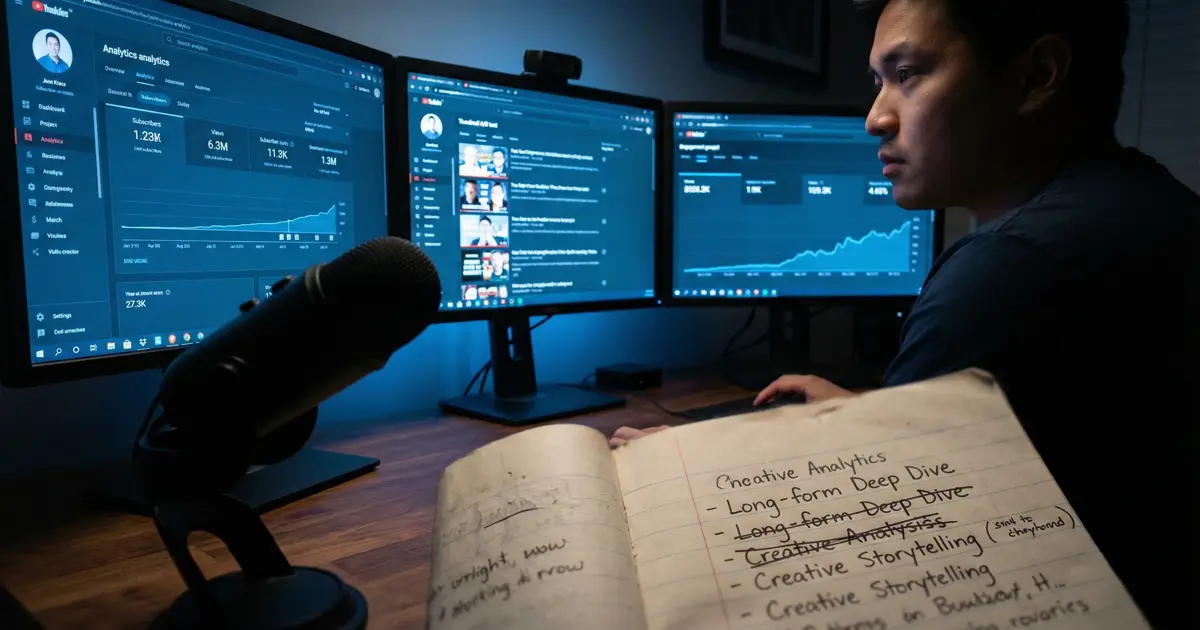
There’s a pattern I can’t unsee anymore. It’s so flipping common.
Plenty of tech commentators on YouTube and podcasts love to rant about algorithms. About AI. About attention. About how recommendation engines are rewiring us, shortening our focus, spoon-feeding us ideas instead of forcing us to think.
They’ll ask the big questions.
- Is this making us dumber?
- Is it killing long-form thinking?
- Are we losing the ability to sit with complexity?
All valid questions.
Then, without missing a beat or the slightest hint of embarrassment for the contradictions, they turn around and feed the very system they warn us about.
Not passively. Strategically.
And that’s where the hypocrisy creeps in.
Participation vs alignment
There’s an important distinction that rarely gets acknowledged.
Uploading a two-hour conversation and letting the chips fall where they may is participation.
You made something long, deep, and slow. You put it out there. If it finds an audience, great. If it doesn’t, that’s the trade-off.
Chopping that same conversation into ten clips, writing algorithm-friendly titles, optimising thumbnails, scheduling drops, maximising surface area, and engineering discoverability is alignment.
At that point, you’re not just using the system. You’re cooperating with it. You’re shaping your output around its incentives.
That difference matters.
“But I have to play the game”
This is where the defence usually comes in.
“I can criticise the system while operating within it.”
“I need to do this to survive.”
“If I don’t play the algorithm game, I disappear.”
All true.
But explanation isn’t absolution.
Most creators aren’t trapped by the algorithm. They’re financially dependent on it. And once income is tied to reach, reach dictates behaviour.
That’s not a moral failing, it’s an economic one.
The problem isn’t that they play the game. The problem is pretending they’re above it while doing so – especially while telling us about the bloody risks of it all.
The missing honesty
Very few people say the quiet part out loud.
“I think this system degrades attention, but it pays my bills.”
“I don’t like what it does to people, but I need its reach.”
“I’m critical of algorithms, and I actively optimise for them.”
All of which is bollocks because I like people to think I know a thing or two about a thing or two but I don’t monetise every sodding thing I write!
But, instead, they position themselves as neutral observers. As if they’re standing outside the system, issuing warnings, untouched by the incentives shaping their own behaviour.
That’s the lie.
Because the algorithm doesn’t just distribute content. It edits it.
How the algorithm reshapes thought itself
Once you start cutting long conversations into short clips, something subtle happens.
You begin speaking in quotable moments. You pause for soundbites. You frame ideas so they survive being ripped from context. You reward punch over process.
Even long-form conversations start bending around short-form incentives.
The system doesn’t silence depth. It slowly starves it, then repackages what’s left into something louder, simpler, and more clickable.
And the people warning us about this are often the most fluent at exploiting it.
This isn’t about villains
This isn’t a hit piece. Well, it kind of is.
Most of these creators aren’t malicious – not deeply. They’re compromised. Just like journalists chasing clicks. Just like businesses chasing engagement. Just like anyone trying to survive inside a system that rewards speed, frequency, and emotional hooks.
But let’s call it what it is.
If you criticise algorithms while actively optimising for them, you’re not just commenting on the machine. You’re part of its supply chain.
That doesn’t invalidate your ideas. It does demand honesty.
Because if we can’t even admit how deeply this stuff shapes us, we’ve already lost the argument.
FAQs and Algorithm Gaming
What’s the difference between participating in algorithms and aligning with them?
Participation means simply uploading your content and letting it find its audience naturally. Alignment means actively shaping your content around algorithmic incentives – chopping videos into clips, engineering thumbnails, optimising titles, and scheduling posts to maximise reach. The key difference is whether you’re just using the platform or actively cooperating with its reward systems.
Is it hypocritical to criticise algorithms while using YouTube or social media?
Not necessarily. The hypocrisy comes when creators criticise algorithmic systems while simultaneously optimising their content specifically for those systems. Simply using a platform isn’t the issue – it’s pretending to stand outside the system while actively engineering content to exploit it. The problem is the lack of honesty about this compromise, not the compromise itself.
How do algorithms change the way creators think and speak?
Once creators start optimising for short-form clips and viral moments, they begin speaking differently even in long-form content. They pause for soundbites, frame ideas to survive being taken out of context, and favour punchy statements over nuanced process. The algorithm doesn’t just distribute content – it shapes how that content gets created in the first place, rewarding what’s quotable over what’s thoughtful.
Why don’t more creators admit they’re financially dependent on algorithms?
Most creators position themselves as neutral observers or critics of the system rather than participants shaped by it. Admitting financial dependence on algorithms would undermine their authority to criticise those same systems. It’s easier to maintain the illusion of standing outside looking in than to acknowledge you’re part of the machine’s supply chain, even if that acknowledgment would be more honest.
Can you criticise a system while operating within it?
Yes, but it requires honesty about the compromises you’re making. You can acknowledge that algorithmic systems degrade attention while admitting you need their reach to pay bills. The issue isn’t participating in flawed systems – we all do that to some degree. The issue is pretending those systems don’t shape your behaviour when they clearly do. Honest criticism from within a system is valid. Pretending you’re somehow immune to its incentives isn’t.